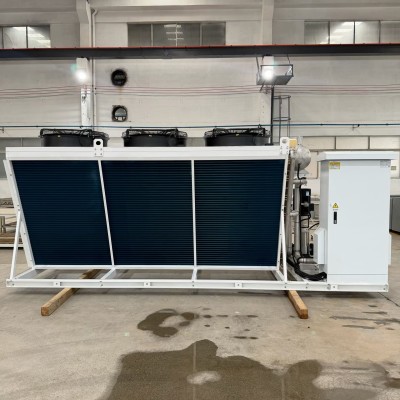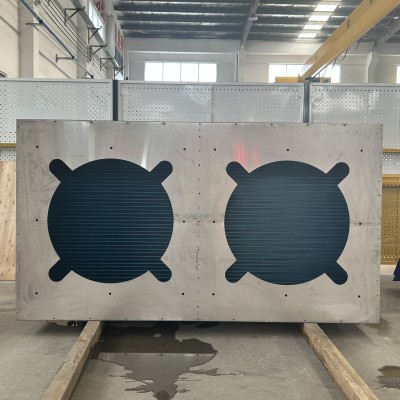
How Dry Coolers Work: The Science of Closed-Loop Heat Rejection
If you have ever wondered how an industrial facility can reject thousands of kilowatts of heat without consuming a single drop of water, the answer is almost always a dry cooler. A dry cooler is an air-cooled heat rejection device that transfers heat from a circulating process fluid — typically a water-glycol mixture — directly to the ambient air, using nothing but finned coils and fans. It is called "dry" because the working fluid never leaves the closed loop and no water is evaporated, in sharp contrast to cooling towers that deliberately evaporate water to reject heat.
In this article, we break down the complete working principle of dry coolers: the closed-loop heat rejection cycle, the major components, the thermodynamics behind the sizing equation, and the practical factors that determine real-world performance — everything you need to specify with confidence.
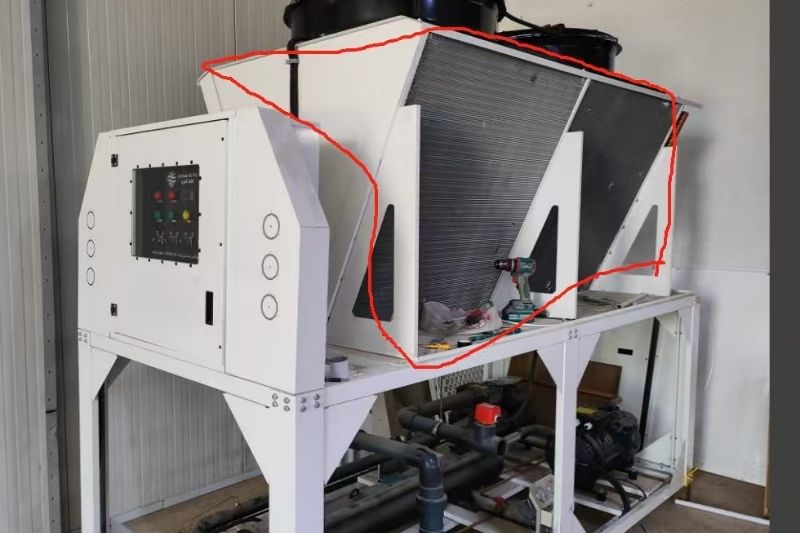 A V-type air-cooled unit rejecting process heat directly to ambient air.
What Is a Dry Cooler and Why Is It Called "Dry"?
A dry cooler is essentially a large, engineered air-to-liquid heat exchanger paired with one or more axial fans. Warm process liquid enters the coil, transfers its heat through tube walls and extended fin surfaces to air forced across the coil, and exits cooler, ready to absorb heat again. The device performs sensible heat rejection: the air temperature rises, but no mass changes phase and no liquid is lost.
The word "dry" distinguishes this technology from wet cooling. In a cooling tower or an evaporative condenser, water is sprayed over a heat exchange surface and a portion of it evaporates, carrying away large quantities of latent heat. That evaporation is effective but consumes enormous volumes of water, demands continuous chemical dosing, and creates biological risks. A dry cooler deliberately gives up the evaporative advantage in exchange for simplicity, water independence, and hygiene.
The Closed-Loop Principle: How Heat Moves from Load to Air
The elegance of a dry cooler lies in its circulation loop. Once filled and commissioned, the same fluid keeps cycling through the system for years. The closed-loop heat rejection process follows five repeating stages:
- 1Heat pickup at the source. The process fluid — commonly a water-glycol mixture for freeze protection — flows through the heat-generating equipment: server racks, power electronics, furnaces, or industrial machinery — and exits carrying the absorbed heat.
- 2Circulation by pump. A circulation pump drives the hot fluid through insulated pipework toward the dry cooler, overcoming the combined pressure drop of the load, the coil, and the piping.
- 3Air-side heat transfer. Inside the dry cooler, the fluid is distributed across finned tube coils. Axial fans force ambient air between the fins, which multiply the contact surface many times over the bare tube area. Heat flows from the fluid, through the tube wall and fin material, into the moving air stream.
- 4Heat carried away. The warmed air — typically 8 to 12°C hotter than the incoming ambient — is discharged upward or sideways, away from the coil face to prevent recirculation.
- 5Return and repeat. The cooled fluid flows back to the heat source, closing the loop. The cycle repeats continuously, modulated only by fan speed control.
Because the circuit is sealed, the fluid is protected from airborne contamination, oxygen ingress is minimized, and corrosion rates are far lower than in open systems — a well-designed closed loop can operate reliably for decades with minimal maintenance.
Key Components: What Is Actually Inside a Dry Cooler
Although a dry cooler looks like a simple box with fans, every element has a specific thermodynamic duty. The main building blocks are:
Finned Tube Coils
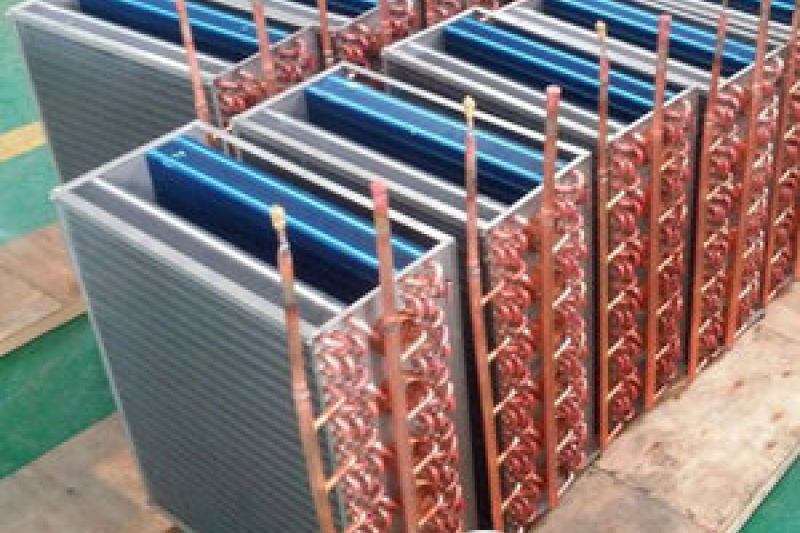
The heat transfer core. Tubes are expanded into fins, creating extended surfaces that raise the effective area by a factor of 15 to 25 over bare tubing. Coil geometry — V-type, flat-type, or vertical — defines the unit's footprint and airflow pattern.
Axial Fans (EC or AC)
Fans supply the air volume that carries heat away. Modern designs increasingly use electronically commutated (EC) fans, which modulate speed continuously and cut fan energy by up to 30% versus fixed-speed AC motors.
Casing and Frame
Galvanized or powder-coated steel structure, often with electrophoretic anti-corrosion protection for coastal or industrial atmospheres, carrying coils, fans, and motors.
Circulation Pump
Mounted at the load or at the cooler, the pump maintains design flow rate through the loop, balancing coil pressure drop against energy consumption.
Expansion Tank
A sealed buffer that absorbs the thermal expansion of the fluid, maintains positive system pressure, and compensates for minor seepage — small but critical to long-term loop health.
Control Panel
Fan speed controllers, temperature sensors, and safety interlocks, with Modbus or BACnet integration so the cooler reports status and accepts setpoints from a plant SCADA or building management system.
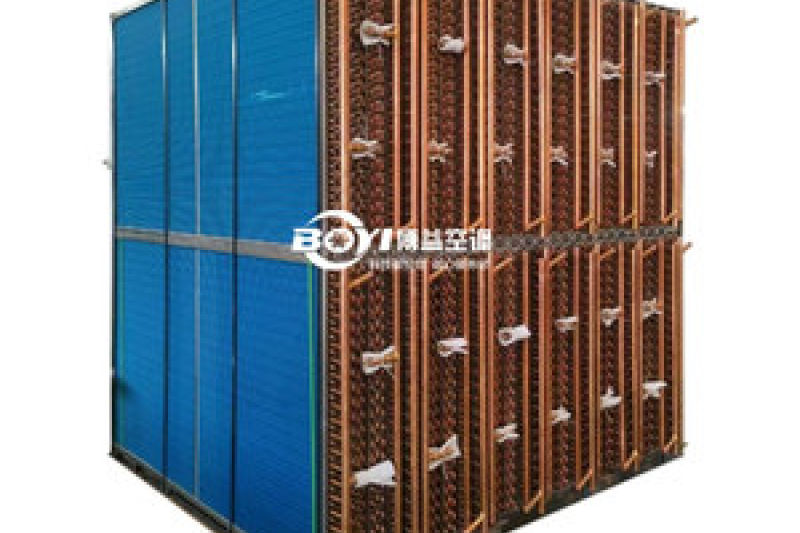 Finned tube coils are the heat transfer heart of every dry cooler.
The Thermodynamics, Simplified: Q = U · A · ΔT
You do not need an engineering degree to understand dry cooler sizing. The entire heat rejection capability is captured in one compact equation: Q = U · A · ΔT, where each symbol has a practical meaning:
Each symbol has a practical meaning:
- Q — the heat rejected, in kilowatts: what your process produces and what the dry cooler must remove.
- U — the overall heat transfer coefficient: how easily heat passes from fluid through tube and fin into air. Better materials and cleaner surfaces raise U.
- A — the total heat transfer surface area, dominated by the fin surface. More coil area or fin density means more A.
- ΔT — the temperature difference between the hot fluid and the ambient air. This is the "driving force" of heat transfer.
The ΔT term explains most real-world sizing conversations. If your process fluid must leave the cooler at 35°C and your design ambient air is 25°C, your driving difference is only 10°C — the machine must be large enough to reject the full load across that narrow gap. The gap between the leaving fluid temperature and the ambient air is called the approach temperature, and shrinking it requires exponentially more surface area or airflow. This is also why a dry cooler that performs perfectly in a Northern European winter will need either more surface, more airflow, or hybrid water assist during a Middle Eastern summer — a consideration that Boyi Cooling's engineers quantify on every custom project before recommending a configuration.
Air-Cooled vs. Hybrid: When Water Assist Boosts Performance
A standard dry cooler relies purely on sensible cooling. A hybrid (adiabatic) version adds water-wetted pads upstream of the coil: on hot days, water evaporates into the incoming air stream, pre-cooling it by several degrees, so the same machine can deliver rated capacity on days when a purely dry unit would fall short.
| Aspect | Pure Air-Cooled (Dry) | Hybrid / Adiabatic Assist |
|---|---|---|
| Water consumption | Zero | Only during peak-temperature hours |
| Hot-climate capacity | Reduced above design ambient | Maintains rated capacity via pre-cooling |
| Maintenance | Minimal — coil cleaning and fan checks | Pad inspection, water quality control |
| Best fit | Temperate, water-restricted sites | Hot regions such as the Middle East |
The decision is site-specific: Boyi Cooling manufactures both pure dry units and V-type coolers with wet curtain pads, and selection always starts with the site's climate profile, water availability, and annual duty hours.
Advantages Over Cooling Towers
For decades, evaporative towers were the default for large heat rejection. Dry coolers now win many of those projects, for reasons that go beyond water savings:
 Sealed-loop construction isolates the process fluid from the atmosphere.
The trade-offs deserve equal honesty: dry coolers reject heat only down to the ambient air temperature, so in hot climates they need more surface area than an equivalent tower. When that is unacceptable, hybrid designs or larger configurations close the gap. A fair comparison should always be made on total cost of ownership — capital, water, chemicals, energy, and maintenance combined.
Performance Factors: What Determines Real-World Output
Manufacturing quality is only half of the performance story; the other half is how well the unit matches its site. Five variables dominate real-world output:
- Ambient temperature profile. Capacity falls as air temperature rises. Sizing must use a statistically representative design ambient for the site — not the absolute record — balancing cost against the few hottest hours per year.
- Approach temperature. The closer the required leaving fluid temperature is to the ambient, the larger and more expensive the cooler becomes. Setting realistic process-side temperature targets is the cheapest capacity lever available.
- Airflow and fan control. Fans must deliver design air volume against coil pressure drop. Variable-speed control preserves capacity while trimming energy and noise at partial loads, where most units spend most of their lives.
- Fin design and cleanliness. Fin density, fin height, and tube pattern set the balance between surface area and air resistance. Dusty environments call for wider fin spacing; fouled fins can silently cut capacity by double-digit percentages.
- Fluid type and glycol concentration. Glycol improves freeze protection but transfers heat less effectively than water, so the mixture should be no stronger than the site's winter actually requires.
When these factors are captured correctly at the selection stage, a dry cooler delivers rated performance for decades; when they are guessed, the usual symptoms are summer overheating or excessive fan energy. This is why a supplier's selection software matters as much as the hardware — at Boyi Cooling, every inquiry is followed by a parameter-verification step before any quotation.
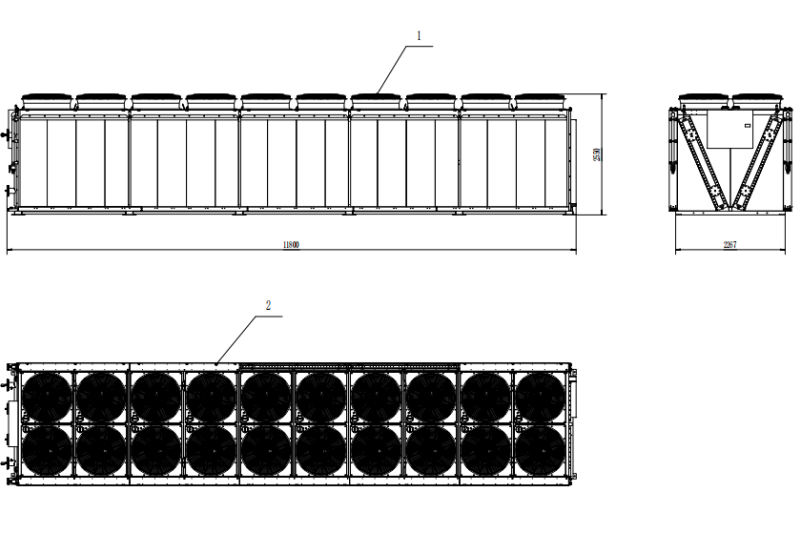
BOYI Customized 2450KW Stainless Steel Tube V-type Dry Cooler for Mining Field
A heavy-duty 2450KW V-type dry cooler with all-stainless steel tube construction for harsh mining environments. Custom-built by Boyi Cooling — 20+ years of thermal engineering experience, exports to 30+ countries.
View Product DetailsFrequently Asked Questions
What fluid runs inside a dry cooler loop?
Most installations use a water-glycol mixture — typically 30% to 50% glycol — selected for the site's lowest expected temperature. In frost-free climates, plain water with corrosion inhibitors is acceptable and transfers heat slightly better.
How close to the ambient air temperature can a dry cooler cool the fluid?
A practical design approach is 5 to 10°C above design ambient. Going tighter is possible but requires rapidly increasing coil area and airflow, so it must be justified by the process requirements.
Do dry coolers work in winter and cold climates?
Yes — cold air is an advantage. Winter operation requires freeze protection: glycol dosing, drain-down provisions, or variable-speed fans idling at low speed to prevent stagnant fluid freezing.
Key Takeaways
- A dry cooler rejects heat from a closed liquid loop to ambient air — no evaporation, no water loss, no chemicals, no Legionella risk.
- The closed-loop cycle is continuous: heat pickup, pumped circulation, air-side transfer across finned coils, warm air discharge, and cooled fluid return.
- Performance is governed by Q = U · A · ΔT: surface area, heat transfer quality, and the fluid-to-ambient temperature gap.
- In hot climates, hybrid adiabatic versions recover full capacity by pre-cooling the inlet air, at the cost of controlled water use during peak hours.
- Compared with cooling towers, dry coolers trade some peak capacity for lower operating complexity and total cost of ownership.
Choosing the right configuration starts with honest site data and ends with an experienced manufacturer. The engineering team at Boyi Cooling can run the thermal calculations for your climate and load profile — reach out via our contact page or send an inquiry, and explore custom units in our product range.