Variable-Speed Fan Technology: How EC Motors Deliver 30% Energy Savings
If you operate a dry cooler or any industrial heat exchanger, the single largest line item in your annual operating budget is almost certainly fan power. Across a typical fifteen-year service life, the electricity consumed by fans routinely exceeds the original purchase price of the equipment by three to five times. Fan technology, not coil surface area, has therefore become the decisive battleground for total cost of ownership in modern data center cooling and process cooling installations.
The good news is that the equation has changed. Electronically commutated (EC) motors paired with variable-speed control now deliver average energy savings of around 30% compared with fixed-speed AC fan systems, and in favorable climates and load profiles the savings climb even higher. In this article, the engineering team at Boyi Cooling explains how EC motor technology works, why the physics of fan affinity laws makes such savings possible, and how to calculate the payback period for your own installation.
Why Fan Energy Dominates the Operating Cost of a Dry Cooler
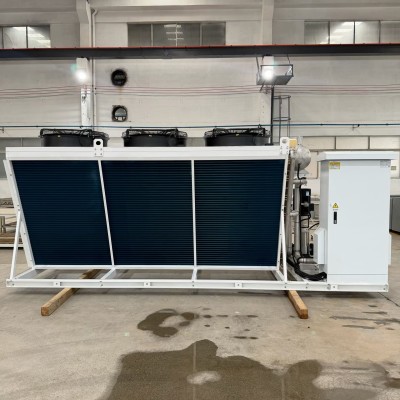
A dry cooler is, at its core, a heat rejection machine: a finned coil surface through which process fluid or glycol circulates, and an array of axial fans that pulls ambient air across that surface. The coil is a passive component with no moving parts and no energy consumption; every kilowatt a dry cooler draws goes to its fans.
Consider a 1 MW heat rejection installation with twelve fans drawing a combined 30 kW. Running continuously, that is roughly 262,800 kWh per year, or more than $31,500 at an industrial electricity price of $0.12 per kWh. Over a fifteen-year life the facility will spend nearly half a million dollars on fan power for this single unit, dwarfing the capital cost of the equipment itself.
Roughly 80% of the lifetime cost of a typical industrial dry cooler is energy, while capital expenditure represents only about 15% and maintenance the remaining 5%. Any technology that reduces fan power therefore attacks the largest cost pool directly, which is why variable-speed fan retrofits so often show payback periods of less than three years.
The traditional response to this cost has been crude: fixed-speed AC induction motors switched in stages, running at full speed regardless of actual heat load. Because a fan only needs its full airflow on the hottest design day at maximum load, this approach wastes enormous energy during the 90%+ of operating hours when conditions are milder. Variable-speed EC technology exists precisely to close that gap.
EC Motors Explained: How They Differ from AC Induction Motors
To understand where the savings come from, you first need to understand what makes an EC motor fundamentally different from the AC induction motors that have powered industrial fans for a century.
An AC induction motor works by inducing a rotating magnetic field in the rotor through the stator windings. This induction process is inherently lossy: energy is lost to slip, to rotor resistance heating, and to magnetizing currents that do no useful work. A typical AC induction motor driving a fan achieves 70% to 85% efficiency at its full-speed design point, and its efficiency collapses rapidly at part load.
An electronically commutated motor takes a different approach. It is essentially a permanent-magnet DC motor with built-in intelligence:
- Permanent magnet rotor. The rotor uses powerful rare-earth magnets instead of induced currents, eliminating rotor slip losses and rotor heating entirely. The magnetic field is always optimally aligned.
- Onboard electronics. An integrated inverter and commutation circuit converts the AC supply to DC and precisely times current delivery to each winding phase, hundreds of times per second.
- Flat efficiency curve. EC motors typically achieve 85% to 92% efficiency, and they hold that efficiency across a very wide speed range, from 20% to 100% of rated speed.
- Native speed control. Because the electronics already manage commutation, accepting a 0-10V, PWM, or Modbus speed command requires no external variable frequency drive, no additional panel space, and no drive-generated harmonics.
The comparison below summarizes the practical differences that matter to a plant operator:
| Characteristic | AC Induction Motor (Fixed Speed) | EC Motor (Variable Speed) |
|---|---|---|
| Peak efficiency | 70-85% | 85-92% |
| Part-load efficiency | Poor, drops sharply below 70% load | Nearly flat from 20% to 100% speed |
| Speed control | Requires external VFD, adds cost and harmonics | Built-in, accepts 0-10V / PWM / Modbus directly |
| Startup current | 5-8x rated current, stresses generators | Soft start inherent, typically under 1.5x rated |
| Motor temperature at low speed | Self-cooling collapses, winding overheating risk | Thermally stable across the speed range |
| Maintenance | Bearings, contactors, belt drives (where used) | Direct-drive options eliminate belts and pulleys |
| Audible noise at part load | Constant, full-speed noise | Scales down with speed, often 10-20 dB(A) quieter |
For a dry cooler or condenser application, the practical translation is simple: an EC fan system moves the same air at design conditions using less energy, and dramatically less energy at the part-load conditions where the equipment actually spends most of its life.
The Fan Affinity Laws: Why a 20% Speed Cut Saves Nearly 50% of Fan Power
The economics of variable-speed fans rest on a piece of physics so favorable it almost seems unfair: the fan affinity laws. For a fixed system (unchanged ductwork, coil, and obstruction), three relationships govern fan behavior as rotational speed changes:
Because power scales with the cube of speed, even modest speed reductions produce outsized power savings. Reduce fan speed by 10%, and power falls to 72.9% of its original value, a 27% saving. Reduce speed by 20%, and power falls to 51.2%, a saving of nearly half.
Why is this so powerful for dry coolers specifically? Because a dry cooler is almost never at design load. Heat rejection equipment is sized for the hottest ambient temperature of the year combined with maximum process load, yet in most climates ambient temperature sits well below the design point for the overwhelming majority of hours. Cooler air means a smaller temperature difference between the fluid and the ambient, so less airflow is needed to reject the same heat, and a variable-speed fan exploits this continuously and automatically.
A bank of fans drawing 40 kW at full speed needs to trim airflow by 20% because the ambient temperature has dropped. Under the affinity law P ∝ n³, the new power draw is 40 × (0.8)³ = 20.5 kW, a 48.8% reduction. Over a 4,000-hour operating season, that single 20% speed trim saves roughly 78,000 kWh, worth about $9,400 per year at $0.12/kWh, from one adjustment the control system makes automatically.
Variable-Speed Control Logic: How the Fan Knows When to Slow Down
EC motors provide the ability to modulate speed; control logic provides the intelligence to decide the right speed at every moment. Modern dry coolers use a layered control strategy built around a closed-loop PID (proportional-integral-derivative) algorithm.
Several refinements distinguish a well-engineered control scheme from a naive one. Minimum-speed floors (often 20-30%) keep fans within their stable operating range, sequential fan staging brings fans on and off line gracefully at very low loads, setpoint reset strategies raise the leaving-fluid setpoint slightly when ambient conditions permit, and deadband logic prevents rapid oscillation, protecting both the process and the mechanical equipment.
Quantified Savings: Where the 30% Figure Comes From
The claim that variable-speed EC fans save around 30% of cooling energy is not a marketing round number; it emerges from bin-hour analysis of real installations. The methodology is straightforward and you can replicate it for your own site.
First, obtain a full-year distribution of ambient temperatures for your location (TMY weather data or your own records). Second, for each temperature bin, determine the fan speed fraction required to hold your target fluid temperature at typical load. Third, apply the affinity law cube to each bin and weight the result by the hours in that bin. Finally, sum the annual energy and compare it against the fixed-speed baseline.
For a representative 500 kW heat load in a temperate climate, the analysis typically looks like this:
A facility rejecting 500 kW of IT load through a dry cooler bank with a total connected fan power of 18 kW. The fixed-speed baseline consumes about 157,700 kWh per year; the same duty served by EC fans under PID control consumes approximately 106,900 kWh, a saving of 50,800 kWh, or 32%. At $0.12/kWh that is $6,100 per year in avoided energy cost, plus reduced demand charges from the soft-start characteristics of EC motors.
In colder climates with long free cooling seasons, the calculated savings regularly reach 40-50%, because the fans spend more hours at deep speed reductions where the cubic law delivers its greatest benefit. In hot, arid climates the savings compress toward 20-25%, and facilities in those regions often combine variable-speed fans with adiabatic cooling stages to restore the temperature advantage.
Boyi Cooling publishes the fan power curves and part-load performance data for every unit it builds, so your engineering team can run exactly this analysis before committing to a specification. With more than 20 years of thermal engineering experience and installations exported to over 30 countries, Boyi's engineers can also model your specific site weather and load profile on request.
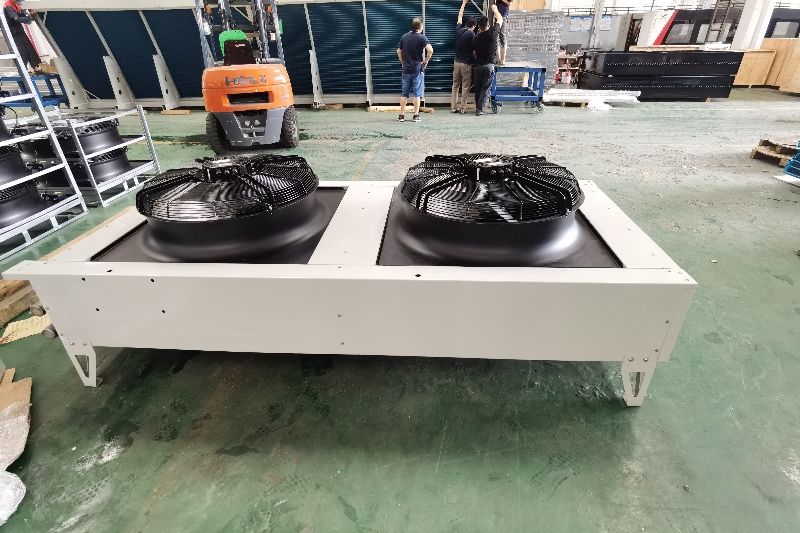
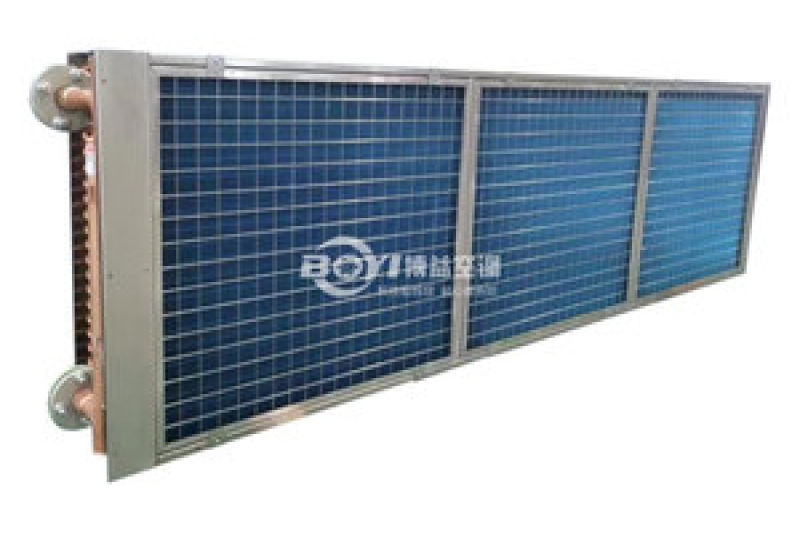
5/8W Copper Tube Flat-type Dry Cooler
Compact flat-type dry cooler with copper tube and aluminum fin coil, engineered for reliable closed-loop heat rejection with variable-speed fan control in hotel, commercial building, and light industrial applications.
View Product DetailsNoise Reduction: The Benefit Nobody Budgets For
Energy savings dominate the financial case for EC technology, but the acoustic benefit is frequently the difference between a project being approved or refused. Fan noise is generated primarily by aerodynamic turbulence at the blade tips and by the motor itself, and both scale down sharply with speed.
Because sound power tracks roughly with the fifth to sixth power of blade tip speed in the dominant frequency bands, a 20% speed reduction typically yields 6 to 8 dB(A) of noise reduction, and a 30% reduction can approach 12 dB(A). Since the decibel scale is logarithmic, a 10 dB(A) reduction is perceived as roughly a halving of loudness. A dry cooler bank that runs at 72 dB(A) at full speed may drop into the low 60s during evening and overnight hours when fans slow to match reduced loads, precisely when residential noise ordinances are most restrictive.
For data centers located near residential zones, hospitals, or office campuses, variable-speed control enables compliance strategies that fixed-speed equipment simply cannot achieve: matching the acoustic footprint to the time of day automatically. Where precise sound data is required, Boyi Cooling can supply units with acoustic measurement reports and low-noise fan blade selections as part of its custom engineering service.
Integration with IoT Platforms and Building Management Systems
A variable-speed fan that cannot talk to the rest of the building is only half a solution. The real leverage of EC technology emerges when fan speed, sensor data, and supervisory control systems work as one.
Modern EC fans expose their full operating state over standard industrial protocols. Each motor's electronics can report actual speed, power draw, motor temperature, runtime hours, and fault codes over Modbus RTU or TCP, turning every fan into a networked sensor and giving facility teams visibility that fixed-speed contactor control never could:
- Continuous performance monitoring. Fan power and speed trends reveal coil fouling, airflow blockage, and fluid-side degradation long before they trigger temperature alarms, enabling predictive rather than reactive maintenance.
- BMS coordination. The dry cooler's controller integrates with the building management system over BACnet or Modbus, so the cooling plant, pumps, and fans are optimized as a single system rather than as isolated machines fighting each other.
- Automated alerting. Deviation from expected fan curves can trigger email or SMS notifications, and with remote access, engineers can diagnose issues without a site visit.
- Energy accounting. Because each fan reports its own power draw, operators can attribute cooling energy precisely, supporting sustainability reporting and ESG disclosure requirements.
The architecture is deliberately simple: the dry cooler controller acts as a Modbus slave (or BACnet device) exposing a register map of setpoints, readings, and status bits, which the BMS or an IoT gateway polls, logs, and supervises. The same integration supports everything from a single rooftop unit to a multi-megawatt data center hall.
Boyi Cooling's Standard Offering: Smart Fans Without the Premium
Many suppliers treat variable-speed fans as an expensive option, quoted as an adder that procurement teams then strip out to hit a capital budget. Boyi Cooling takes the opposite position: variable-speed EC fans are offered as a standard capability on its dry cooler ranges, alongside remote monitoring provisions and BMS integration support.
This philosophy reflects how the company has engineered heat exchangers for more than two decades. With over 20 years of thermal engineering experience, an in-house manufacturing base, and completed projects exported to more than 30 countries, Boyi builds each unit around the customer's actual operating profile rather than a one-size-fits-all catalog configuration: fans selected for the real duty cycle, coils circuited for the real fluid, and controls configured for the real communication environment, whether that is a Modbus-connected mining container or a BACnet-supervised hospital plant room.
Buyers evaluating suppliers can request part-load fan power data, control logic descriptions, and protocol documentation as part of the quotation package; a manufacturer who cannot readily supply these has not engineered for part-load operation. You can request a customized quotation or contact our engineering team directly with your site conditions.
Payback Analysis: When Does the EC Premium Repay Itself?
EC fans carry a component cost premium over fixed-speed AC motors, typically adding 8% to 15% to the equipment price depending on unit size and fan count. Whether that premium is money well spent depends on three variables: annual operating hours, electricity price, and the part-load profile of your application. The table below shows indicative simple payback periods for a representative premium on a 500 kW-class dry cooler (approximately $4,500 premium, $6,100 annual baseline energy cost, 32% saving in a temperate climate):
| Operating Profile | Hours/Year | Energy Price | Annual Saving | Simple Payback |
|---|---|---|---|---|
| Seasonal commercial (hotel, office) | 3,000 | $0.12/kWh | ~$3,400 | ~1.3 years |
| Continuous industrial process | 8,760 | $0.12/kWh | ~$6,700 | ~0.7 years |
| Data center, 24/7 high load factor | 8,760 | $0.18/kWh | ~$10,100 | ~0.5 years |
| Mining farm, hot climate | 8,760 | $0.08/kWh | ~$4,000 | ~1.1 years |
| Cold climate free cooling heavy | 8,760 | $0.12/kWh | ~$8,500 | ~0.5 years |
Three observations deserve emphasis. First, in continuous-duty applications the premium is repaid so quickly that specifying fixed-speed fans is difficult to justify financially. Second, high electricity prices and cool climates both accelerate payback, because they respectively increase the value of each saved kilowatt-hour and increase the number of deep part-load hours. Third, the analysis deliberately excludes secondary benefits on top of the energy savings: reduced demand charges from soft starting, avoided VFD panel cost, longer component life from gentler operation, and quieter sites. Including these typically improves payback by a further 10% to 20%.
Frequently Asked Questions
Conclusion: Specify the Fan System Your Operating Budget Deserves
Variable-speed EC fan technology changes the economic identity of a dry cooler from an energy-hungry necessity into an actively optimized asset. The physics is settled: fan power scales with the cube of speed, real installations spend most of their lives below design load, and a controller that exploits those two facts saves roughly 30% of fan energy on average while cutting noise, easing demand charges, and feeding data into your building systems.
When evaluating your next heat exchanger or cooling unit, ask every supplier the same three questions: What is the fan power curve at 50% speed? How is the control loop structured? What protocol documentation will I receive? The answers separate equipment engineered for part-load reality from equipment engineered only for the brochure. Boyi Cooling builds every dry cooler with variable-speed capability available as standard, backed by more than 20 years of thermal engineering experience, in-house custom manufacturing, and a delivery record spanning more than 30 countries. To model the savings for your specific site, send us your project parameters for a selection with quantified part-load performance.