V-Type vs. Flat-Type vs. Vertical Dry Coolers: Choosing the Best Configuration
When specifying a dry cooler for an industrial or commercial cooling application, selecting the right physical configuration is one of the most consequential early-stage decisions. Dry coolers come in three principal form factors—V-type, flat-type (horizontal), and vertical—each with distinct advantages, trade-offs, and application sweet spots. A configuration that works brilliantly in a hyperscale data center may be entirely impractical on a constrained rooftop. This article provides an engineering-level comparison of the three configurations, supported by real-world application data from Boyi Cooling's 20+ years of heat exchanger manufacturing experience.
Why Dry Cooler Configuration Is a First-Order Design Decision
Dry cooler configuration affects more than physical dimensions. The form factor directly influences heat rejection surface area per unit of footprint, airflow path efficiency, fan power consumption, noise propagation patterns, maintenance access ergonomics, and structural loading requirements. Selecting a configuration without analyzing these interdependencies can lead to avoidable problems: excessive fan power from suboptimal airflow paths, cooling capacity degradation from hot air recirculation in tight spaces, and unexpected downtime from inadequate service clearances.
Most reputable manufacturers, including Boyi Cooling, offer multiple configurations and advise customers on the optimal form factor based on site-specific parameters including footprint area, height restrictions, prevailing wind direction, noise sensitivity, and integration with existing heat exchanger infrastructure. The configuration decision should precede detailed thermal design—retrofitting thermal specifications onto a suboptimal form factor late in the project lifecycle frequently results in costly redesigns.
Key Design Factors Influencing Configuration Choice
- Available footprint area — ground-level vs. rooftop vs. wall-mounted space
- Height restrictions — local zoning codes, sight-line requirements, structural limitations
- Airflow management — hot air recirculation risk, prevailing wind, adjacent equipment
- Noise constraints — proximity to residential areas, occupational noise exposure limits
- Maintenance access — clearance for coil cleaning, fan motor replacement, header inspection
- Expansion planning — modularity and future capacity scaling requirements
V-Type Dry Coolers: The Industry-Dominant Form Factor
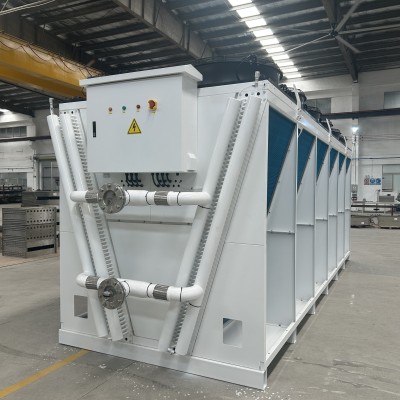
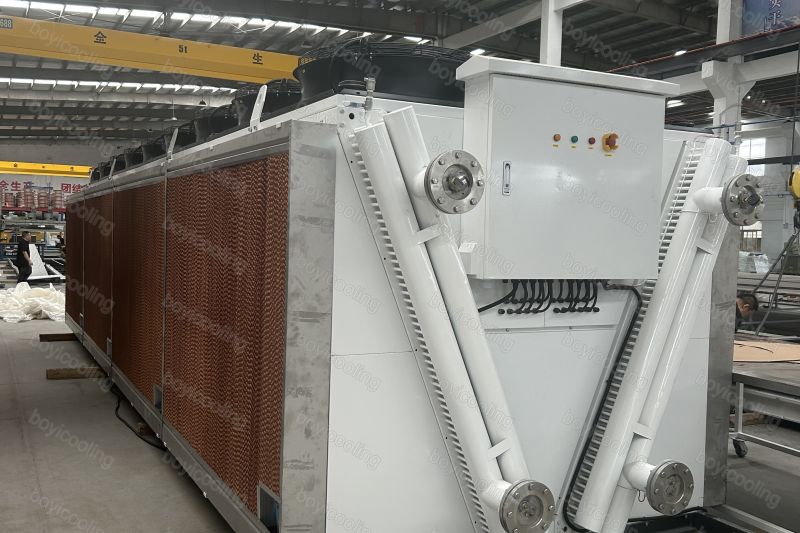
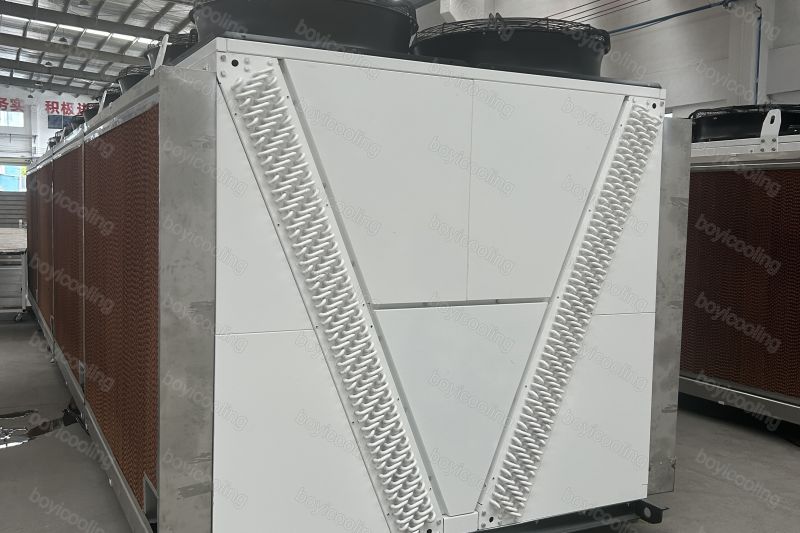
V-type dry coolers are by far the most widely specified configuration in medium-to-large-scale commercial and industrial applications, and for sound engineering reasons. In a V-type design, two fin-and-tube heat exchanger coils are arranged in an inclined V-shape, typically at an angle between 30° and 45° relative to vertical. Fans are mounted on the top horizontal plane, pulling ambient air through both angled coil faces and discharging it vertically upward. This geometry produces a significantly larger heat exchange surface area per unit of ground footprint compared to either flat or vertical configurations.
Engineering Advantages of the V-Type Configuration
The V-type geometry achieves a high coil-face-area-to-footprint ratio, which translates directly into higher heat rejection capacity per square meter of occupied ground space. For a given cooling duty, a V-type unit typically requires 30–50% less footprint than an equivalent-capacity flat-type unit. This density advantage is particularly valuable in multi-unit data center installations where floor space is at a premium and equipment layout must accommodate service aisles, piping corridors, and future expansion capacity.
Airflow dynamics also favor the V-type design. Because air is drawn through both inclined coil faces simultaneously and discharged vertically, the overall airflow path is shorter and more balanced than in flat-type configurations where air must navigate a single horizontal coil bank. This balanced two-sided airflow reduces fan static pressure requirements, which in turn reduces fan motor power consumption—a factor that becomes increasingly significant at scale when dozens of units operate continuously.
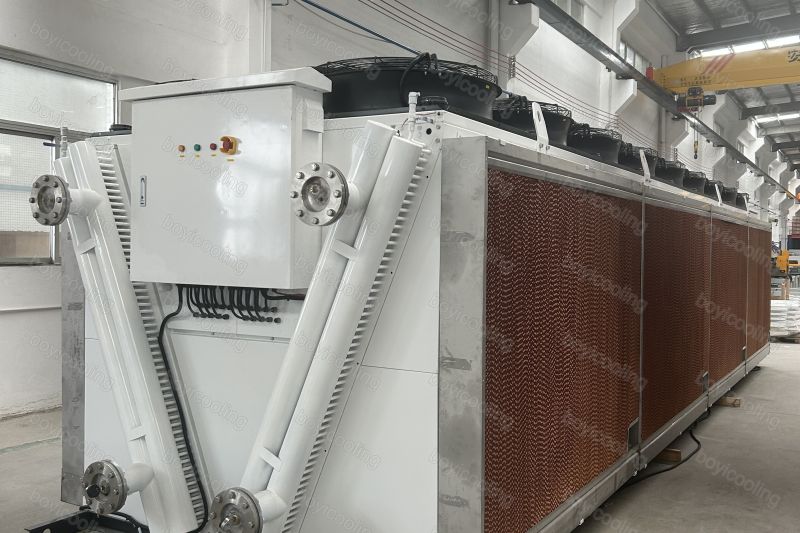
V-type dry cooler with inclined dual-coil geometry maximizes heat exchange surface area per unit of ground footprint.
Modularity and Scalability
V-type dry coolers lend themselves naturally to modular deployment strategies. Multiple V-type units can be arranged in parallel rows with consistent service clearances, allowing data center operators and industrial facility managers to add cooling capacity in phased increments as thermal load requirements grow. Boyi Cooling has delivered numerous multi-unit V-type installations where the initial deployment covers current IT load plus a defined expansion margin, with pre-positioned pipe headers and electrical infrastructure enabling rapid deployment of additional units without disrupting existing cooling operations.
V-Type at a Glance
Strengths:
- Highest coil-area-to-footprint ratio
- Efficient two-sided airflow
- Excellent modular scalability
- Proven in hyperscale deployments
Considerations:
- Requires overhead clearance for vertical exhaust
- Higher overall height than flat-type
- Coil cleaning access requires planning
Flat-Type (Horizontal) Dry Coolers: The Low-Profile Workhorse
Flat-type dry coolers, also referred to as horizontal dry coolers, arrange the heat exchanger coil in a single horizontal plane with fans drawing or pushing air vertically through the coil bank. This configuration produces a low overall unit height—typically 1.5 to 2.5 meters depending on capacity—which makes flat-type units the configuration of choice for rooftop installations, low-clearance mechanical yards, and applications where zoning restrictions limit equipment height above a certain elevation.
Where Flat-Type Configuration Excels
Rooftop installations represent the primary application domain for flat-type dry coolers. In urban commercial buildings, hospitals, hotels, and multi-tenant office facilities, cooling equipment space is frequently limited to rooftop mechanical penthouses subject to strict height limitations imposed by local planning authorities. Flat-type units fit naturally into these environments because their low profile minimizes visual impact and reduces wind loading on the building structure.
Flat-type configurations also simplify retrofit scenarios. When replacing legacy cooling towers or upgrading from chiller-based systems to a dry cooling approach, existing structural steel support frames, pipe risers, and electrical infrastructure are often sized for low-profile equipment. Selecting a flat-type dry cooler can substantially reduce structural modification scope, leading to shorter project timelines and lower total installed cost.
Flat-type dry cooler configuration with single horizontal coil plane, ideal for low-clearance and rooftop applications.
Performance Trade-Offs
The flat-type configuration's primary trade-off is a larger ground footprint per unit of heat rejection capacity compared to V-type designs. Because all heat exchange surface is distributed across a single horizontal plane, flat-type units require roughly 40–60% more footprint area for equivalent capacity. Additionally, the single-coil airflow path means fans must overcome higher static pressure, resulting in marginally higher energy consumption. However, for applications where height is the binding constraint and ground area is available—as with large-footprint commercial buildings—these trade-offs are entirely acceptable.
Noise performance differs between configurations. In rooftop installations, upward-discharging flat-type units often produce lower noise at pedestrian level than horizontally-discharging equipment—a meaningful advantage in mixed-use urban developments.
Vertical Dry Coolers: The Compact Solution for Tight Spaces
Vertical dry coolers orient the heat exchanger coil in a vertical plane, with fans mounted on the side or top of the unit to draw air horizontally or vertically through the coil. This configuration produces the smallest footprint of all three form factors, typically occupying 60–80% less ground area than an equivalent-capacity flat-type unit. Vertical dry coolers are the configuration of choice for edge data centers, telecommunications facilities, containerized cooling modules, and retrofit projects where available floor space is severely constrained.
Ideal Applications
The rise of edge computing has created a significant market for vertical dry coolers. Edge data centers frequently occupy converted retail spaces, telecommunications shelters, or modular containerized buildings where every square meter carries a high economic cost. Vertical dry coolers can be mounted against exterior walls or integrated into containerized cooling skids, freeing interior floor area for IT equipment.
Vertical units also excel in retrofit installations. When a facility upgrades from older cooling technology, the mechanical room may have been designed around vertically oriented equipment. A vertical dry cooler can often fit within the same footprint as the legacy equipment being replaced, minimizing building modifications, pipe rerouting, or structural reinforcement.
Vertical dry cooler configuration with minimal footprint, designed for edge data centers and space-constrained retrofit applications.
Capacity Considerations
The vertical configuration's capacity ceiling is generally lower than V-type or large flat-type units because the single vertical coil face limits total heat exchange surface area within a compact envelope. For applications requiring more than 500–800 kW per unit, a V-type or flat-type configuration typically becomes more practical. However, multiple vertical units can be arranged in parallel to meet higher total cooling demands.
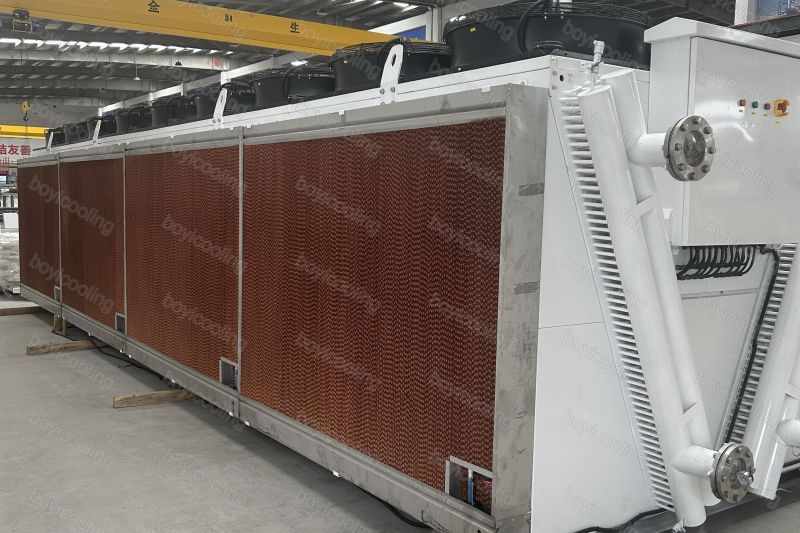
Boyi Cooling offers all three dry cooler configurations and provides engineering guidance to help customers select the optimal form factor based on site-specific constraints. With 20+ years of thermal engineering experience and custom manufacturing for over 30 countries, Boyi's engineering team can evaluate your parameters and recommend the configuration that best balances performance, footprint efficiency, and total cost of ownership.
Side-by-Side Configuration Comparison
The table below provides a structured comparison of the three dry cooler configurations across the criteria most relevant to industrial and commercial cooling specification.
| Evaluation Criterion | V-Type | Flat-Type (Horizontal) | Vertical |
|---|---|---|---|
| Footprint Efficiency | Excellent 30–50% less area than flat-type for equivalent capacity |
Moderate Largest footprint per kW of heat rejection |
Excellent 60–80% less area than flat-type |
| Heat Rejection Capacity Range | 50 kW – 5+ MW per unit Widest available range |
30 kW – 2 MW per unit Moderate range |
20 kW – 800 kW per unit Lower per-unit ceiling |
| Airflow Pattern | Dual-sided intake, vertical upward discharge | Bottom or side intake, vertical upward discharge | Side intake, side or top discharge |
| Fan Power Efficiency | High Lowest static pressure per unit airflow |
Moderate Higher static pressure than V-type |
Moderate Depends on coil depth and fan placement |
| Noise Level (Typical) | Moderate to High Fan noise directed upward |
Low to Moderate Upward discharge reduces ground-level noise |
Low to Moderate Side discharge may require acoustic treatment |
| Overall Height | 2.5 – 5.0 m | 1.5 – 2.5 m | 2.0 – 4.0 m |
| Maintenance Access | Moderate — V-angle may complicate coil cleaning access | Good — flat coil plane simplifies cleaning and inspection | Good — vertical face accessible from front |
| Modular Expandability | Excellent Proven in multi-unit data center layouts |
Good Requires larger total site area |
Good Small footprint enables incremental expansion |
| Typical Installed Cost (Relative) | $$$ Higher unit cost, lower footprint cost |
$$ Lower unit cost, higher footprint cost |
$$ Moderate unit cost, lowest footprint cost |
Ratings are indicative based on typical commercial and industrial installations. Actual values vary with capacity, ambient conditions, materials, and project-specific requirements. For a detailed configuration analysis tailored to your project, contact Boyi Cooling's engineering team.
Application Matching: Which Configuration for Which Use Case?
While the comparison table above provides a technical framework for evaluation, the decision is ultimately driven by the specific application context. The following guidance maps common cooling application scenarios to their typically optimal dry cooler configurations, based on Boyi Cooling's experience across hundreds of installations worldwide.
Hyperscale and Colocation Data Centers → V-Type
Large-scale data centers with multi-megawatt cooling demands benefit most from the V-type configuration's combination of high capacity density, modular scalability, and proven operational track record. The ability to deploy rows of V-type units with consistent service clearances and predictable airflow patterns simplifies site planning and reduces the risk of hot air recirculation—a common cause of cooling capacity degradation in densely packed equipment yards. Boyi Cooling has delivered V-type installations ranging from 930 kW to 3.3 MW per unit for data center operators across Asia, the Middle East, and Europe.
Rooftop and Low-Clearance Installations → Flat-Type
Commercial buildings, hospitals, hotels, and multi-tenant office facilities with rooftop equipment zones are the natural domain of flat-type dry coolers. The low profile minimizes structural wind loading, complies with height restrictions common in urban planning codes, and reduces visual impact—an important consideration for building owners and facility managers in aesthetically sensitive locations. Flat-type units also integrate effectively with existing rooftop pipe headers and electrical service infrastructure originally designed for cooling towers or air-cooled chillers.
Edge Data Centers and Compact Facilities → Vertical
Edge computing facilities, telecommunications shelters, modular containerized data centers, and retrofit installations within existing mechanical rooms are best served by vertical dry coolers. The minimal footprint allows deployment in spaces where V-type or flat-type units would be physically impossible to install, and the ability to mount units against walls or integrate them into containerized cooling skids provides installation flexibility that other configurations cannot match.
Industrial Process Cooling → Application-Dependent
Industrial process cooling applications—including plastic injection molding, food and beverage processing, chemical manufacturing, and metalworking—do not have a single universally optimal configuration. The choice depends on plant floor space, ceiling height, ambient temperature profile, process fluid characteristics, and integration with existing equipment. Boyi Cooling's engineering team works with industrial customers to evaluate site conditions and recommend the appropriate configuration.
Boyi Cooling Case Examples: Configuration in Practice
The following real-world project examples illustrate how configuration selection plays out in practice across different application environments. These cases are drawn from Boyi Cooling's project portfolio and demonstrate the engineering rationale behind each configuration decision.
V-Type: 2.5 MW Data Center Cooling
A hyperscale data center operator in Southeast Asia required 2.5 MW of dry heat rejection capacity per unit for a new multi-megawatt facility. The equipment yard area was constrained by site boundaries, making footprint efficiency a primary selection criterion. Boyi Cooling supplied multiple 2.5 MW stainless steel tube V-type dry coolers arranged in parallel rows with dedicated service aisles. The V-type configuration's high coil-area-to-footprint ratio accommodated the full cooling capacity within the available yard area, with vertical upward discharge minimizing hot air recirculation risk between adjacent unit rows.
Flat-Type: Hotel Cooling System Retrofit
A five-star hotel in a coastal city needed to replace aging cooling towers on a rooftop mechanical penthouse subject to strict height restrictions imposed by the local municipal planning authority. The existing structural steel support frame had been designed for low-profile equipment with a maximum height of 2.2 meters. Boyi Cooling supplied flat-type dry coolers that fit within the existing support frame and height envelope, eliminating the need for structural modifications and reducing project delivery time by approximately eight weeks compared to a V-type alternative that would have required structural reinforcement and planning permission amendments.
V-Type: 3.0 MW Mining Field Cooling
A mining operation in a remote arid region required 3.0 MW of process cooling capacity for mineral processing equipment. The site's ambient temperatures regularly exceeded 45°C during summer months, requiring a high-capacity, robust cooling solution. Boyi Cooling supplied stainless steel tube V-type dry coolers with corrosion-resistant coatings suitable for the dusty, high-temperature operating environment. The V-type configuration was selected for its high capacity density and proven reliability in harsh industrial environments, with all units engineered for minimal on-site maintenance requirements given the remote location.
Non-Standard Configurations: When Standard Form Factors Fall Short
While the three standard configurations cover most commercial and industrial cooling applications, certain projects present spatial, acoustic, or operational constraints that demand a non-standard approach. Boyi Cooling's custom manufacturing capability enables the company to design and produce dry coolers in configurations beyond conventional form factors.
Custom Configuration Capabilities
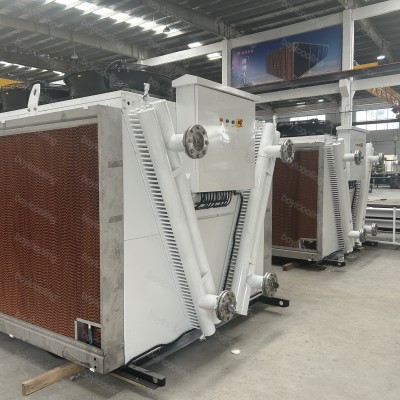
Boyi Cooling can engineer non-standard configurations including split-coil arrangements where heat exchange surface is distributed across multiple separately housed coil banks; low-noise configurations with oversized fans operating at reduced RPM and integrated acoustic enclosures; dual-temperature configurations where different coil sections serve different supply water temperature setpoints; and hybrid configurations combining dry cooling with adiabatic pre-cooling via wet curtain media for peak summer performance. Each custom configuration is supported by Boyi's in-house thermal design software, which models heat transfer performance, pressure drop, and fan power consumption before fabrication begins.
The Boyi Cooling Advantage in Custom Configurations
- 20+ years of thermal engineering experience spanning data center, industrial process, HVAC, and power generation cooling applications
- In-house 2D/3D design capability enabling rapid custom configuration development and customer approval workflows
- Proprietary thermal selection software that models configuration-specific performance before fabrication begins
- Export experience across 30+ countries with documented compliance with regional codes, standards, and certification requirements
- Full manufacturing control from fin stamping and tube bending through coil assembly, pressure testing, and final quality inspection
For projects requiring a configuration that does not fit neatly into the V-type, flat-type, or vertical categories, Boyi Cooling's engineering team can develop a tailored solution. The process begins with a detailed requirements consultation covering site dimensions, cooling capacity targets, ambient conditions, noise limits, and any specific integration constraints, followed by a custom configuration proposal with 2D layout drawings and predicted performance data.
Frequently Asked Questions
Which dry cooler configuration is most energy-efficient?
V-type dry coolers typically achieve the highest fan energy efficiency (lowest kW per kW of heat rejection) due to their dual-sided airflow design, which reduces static pressure and fan motor power requirements compared to single-coil configurations. However, the difference is typically 5–15% and may be outweighed by site-specific constraints such as available footprint or height restrictions.
Can I mix different configurations in a single installation?
Yes. Multi-configuration installations are not uncommon, particularly in facilities with heterogeneous space constraints. For example, a data center campus might use V-type units in the primary equipment yard where space is available and flat-type units on an auxiliary building rooftop where height is restricted. Boyi Cooling supports mixed-configuration designs and ensures consistent control interfaces across all unit types for unified BMS integration.
What is the smallest footprint configuration for a given capacity?
Vertical dry coolers offer the smallest footprint per unit but have the lowest per-unit capacity ceiling (typically 500–800 kW). V-type units offer the next-smallest footprint with much higher capacity ceilings (up to 5+ MW per unit). For applications where both high capacity and minimal footprint are required, V-type is generally the optimal choice.
How does Boyi Cooling help customers select the right configuration?
Boyi Cooling's engineering team evaluates site-specific parameters including available space, height restrictions, noise limits, ambient temperature profile, required cooling capacity, and integration with existing infrastructure. Based on this analysis, the team provides a configuration recommendation supported by preliminary layout drawings and predicted performance data. Customers can also submit an inquiry with their project parameters to receive a tailored configuration analysis and quotation.
Making the Right Configuration Decision
Choosing between V-type, flat-type, and vertical dry cooler configurations is fundamentally a site-constraint optimization problem rather than a pure thermal engineering exercise. The optimal configuration is the one that satisfies the project's cooling capacity requirements while respecting footprint limitations, height restrictions, noise constraints, maintenance access needs, and budget parameters—and that can be installed, commissioned, and operated reliably over a 15-to-25-year service life.
Boyi Cooling's approach to configuration selection is grounded in engineering analysis rather than marketing preference. The company manufactures all three configurations and provides objective, data-driven guidance based on each customer's unique site conditions and operational requirements. Whether your project calls for a high-density V-type installation in a hyperscale data center, a low-profile flat-type deployment on a constrained rooftop, or a compact vertical unit for an edge computing facility, Boyi has the manufacturing capability, engineering expertise, and project experience to deliver a solution that performs as specified.
To discuss your project's cooling requirements and receive a configuration recommendation, submit an inquiry with your site parameters, or visit the dry cooler product page to explore standard and custom configurations. With 20+ years of heat exchanger manufacturing experience and installations in over 30 countries, Boyi Cooling is your trusted partner for industrial and commercial dry cooling solutions.