The Evolution of Heat Exchanger Materials: From Copper to Advanced Alloys
Every efficiency gain, every avoided corrosion failure, and every decade of extra service life traces back to one decision made before the unit reached the job site: the choice of tube and fin materials. While fans and controls get most of the attention, material innovation remains the silent driver behind performance leaps in dry coolers, condensers, and evaporators. From the copper coils of the twentieth century to today's all-stainless constructions and electrophoretic coatings, this evolution is the story of an industry learning to fight corrosion, pressure, and temperature one alloy at a time.
Why Materials Define Heat Exchanger Performance
A finned tube heat exchanger is fundamentally a heat-transfer machine, and heat transfer begins at the material level. The tube wall must conduct heat to the fin surface; the fin must spread it into the airstream; and the assembly must survive its environment for 15 to 20 years without leaking or corroding. No single material excels at all three, so selection is always a trade-off between conductivity, strength, weight, cost, and corrosion resistance.
Get the trade-off wrong and the consequences compound over time. A copper-fin coil on a coastal wastewater plant may lose its fins to galvanic corrosion within five years; an all-aluminum microchannel unit in a chemical workshop can suffer irreversible pitting. Overspecifying all-stainless for a clean indoor air handler adds cost without adding life. Knowing where each material wins is the foundation of smartation of smart procurement — and the reason experienced manufacturers like Boyi Cooling, with more than 20 years of thermal engineering experience and exports to over 30 countries, evaluate every project's environment before recommending a tube-fin combination.
The three properties that matter most
Thermal Conductivity
How quickly heat moves through tube wall and fin: copper leads at ~400 W/m·K, aluminum follows at ~237, stainless trails at 16 but compensates with durability.
Corrosion Resistance
Survival in humid, saline, acidic, or chemically loaded air: stainless steel and coated aluminum dominate wherever moisture, chlorides, or fumes are present.
Strength & Pressure Tolerance
Wall thickness, weight, and burst margin: carbon and stainless steel carry high-pressure duties that lighter metals cannot safely handle.
The Traditional Trio: Copper, Aluminum, and Carbon Steel
For most of the industry's history, three materials covered nearly every application, each earning its place through a distinct combination of properties.
Copper: the conductivity benchmark
With thermal conductivity near 400 W/m·K — roughly eight times that of stainless steel — copper remains the reference point for compact, high-efficiency coils. It forms strong brazed joints, resists many water-side contaminants, and is inherently antimicrobial, a quiet advantage in hospital and food-processing air handlers. Copper tube with aluminum fin (Cu/Al) is still the default for air-conditioning condensers, chilled water coils, and heat pump evaporators worldwide. Its limits are price volatility and vulnerability to ammonia and sulfide-bearing atmospheres.
Aluminum: the lightweight workhorse
Aluminum offers about 237 W/m·K of conductivity at a third of copper's density and a fraction of its cost. Extruded into fins, it maximizes secondary surface area per kilogram; formed into microchannel tubes, it enables some of the most compact heat exchangers on the market. Its natural oxide layer gives acceptable corrosion resistance in dry, neutral environments, though chlorides and strong alkalis defeat it quickly, and galvanic coupling with copper tubes in wet conditions requires careful coating or isolation.
Carbon steel: the pressure specialist
Where temperatures climb and pressures bite — steam coils, thermal oil systems, high-pressure process loops — carbon steel delivers strength that copper and aluminum cannot match. Its conductivity is modest (around 50 W/m·K), but for sensible heat duties in protected, treated-water systems it performs reliably and inexpensively. Without coatings or water treatment, however, carbon steel rusts rapidly on the air side, which is why it rarely appears uncoated in outdoor dry cooler applications.
| Material | Conductivity (W/m·K) | Corrosion Resistance | Typical Duty |
|---|---|---|---|
| Copper | ~400 | Good (poor vs. ammonia/sulfides) | AC condensers, chilled water coils, evaporators |
| Aluminum | ~237 | Moderate (fails in saline/alkaline) | Fins, microchannel coils, heat pump exchangers |
| Carbon Steel | ~50 | Poor unless coated | Steam coils, thermal oil, high-pressure process |
| Stainless Steel | ~16 | Excellent (incl. chemical/marine) | Dry coolers, surface coolers, aggressive media |
The Stainless Steel Revolution in Corrosive Environments
The most consequential material shift of the past two decades has been the migration of demanding applications to all-stainless-steel construction. Stainless steel trades conductivity for longevity: at roughly 16 W/m·K it transfers heat far more slowly than copper, but it shrugs off the chlorides, acids, and organic loads that destroy softer metals. In a well-designed coil, generous fin surface area and optimized air velocity recover most of the conductivity deficit — and the coil keeps working for decades where a copper coil would need replacement.
Chemical plants, marine installations, wastewater facilities, food and pharmaceutical lines, and data center cooling systems with glycol loops have all driven demand for stainless tube paired with stainless fin. The configuration eliminates galvanic couples entirely: tube, fin, frame, and casing share the same alloy family, so no sacrificial metal exists for moisture to corrode preferentially. Field experience shows all-SS coils routinely exceeding 50,000 operating hours in environments that retire Cu/Al coils in under ten years.
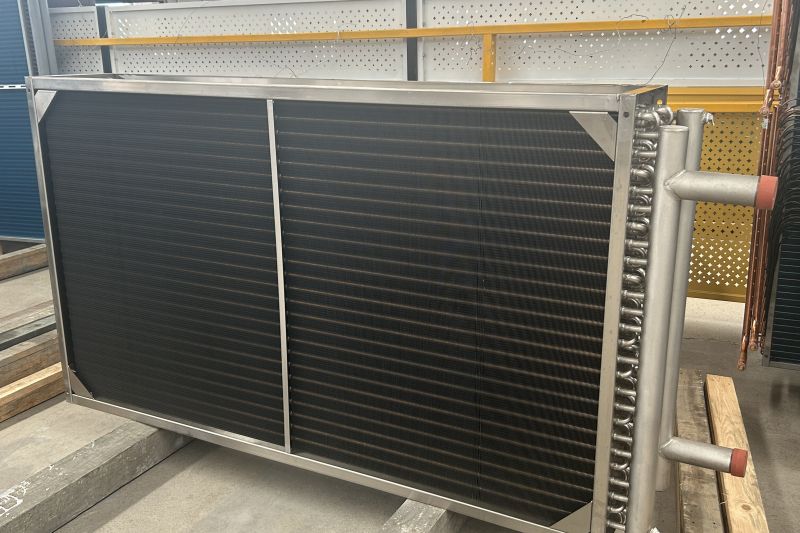
Modern fabrication has also erased the old objections to stainless coils: laser welding and automated finning produce consistent thermal contact, and all-SS dry coolers now range from 60 kW chemical-industry units to multi-megawatt V-type arrays for data centers and mining farms. When buyers compare stainless steel heat exchanger options for dry coolers and industrial cooling duty, the lifecycle math increasingly favors stainless despite the higher initial price — particularly anywhere washdown, salt fog, or process emissions are part of daily reality.
Advanced Coatings: Protecting Without Compromising
Between pure copper economics and full stainless budgets lies a third path: keep the conductive metal and engineer its surface. Coating technology has matured into a genuine materials discipline, and three families dominate industrial practice.
Electrophoretic (E-Coating)
The coil is immersed in an epoxy bath and an electric field deposits the coating uniformly, reaching between fins that sprays miss. A 15–25 µm cathodic epoxy layer passes 1,000+ hours of salt spray testing and is the standard defense for coastal HVAC and industrial dry coolers.
Epoxy & Phenolic Sprays
Spray-applied barriers tailored to specific chemistry: phenolics excel against acidic condensate and cleaning agents, while thick-film epoxies guard against sulfides and brines. Fin spacing is often widened so coated fins keep airflow resistance low.
Hydrophilic Coatings
A thin hydrophilic layer lowers the contact angle so condensate sheets off the fin instead of bridging between them — preserving airflow and improving heat transfer on coils that run wet.
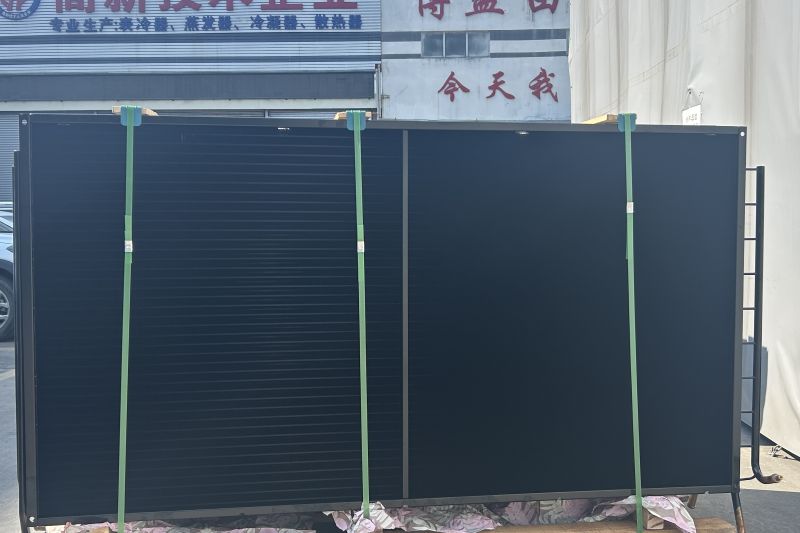
Coatings do not replace good material choice — they extend it. A copper-tube coil with electrophoretic treatment can serve a coastal rooftop for 15 years at a fraction of all-stainless cost, while an uncoated coil on the same roof fails in five. The judgment lies in matching the coating to the actual contaminant profile, which is why spec sheets that simply say "corrosion protected" are rarely sufficient: demand salt-spray test hours, coating thickness data, and reference installations.
Emerging Materials: Titanium, Hastelloy, and Graphite
Above stainless steel sits a tier of specialty materials reserved for environments that defeat even 316L, each commanding a premium price and a narrow, justified niche.
- Titanium alloys are virtually immune to seawater and chlorinated brines. Titanium exchangers serve desalination plants, offshore platforms, and aquarium systems where other metals perforate within months, and its conductivity of about 22 W/m·K is workable thanks to thin walls enabled by titanium's strength.
- Hastelloy C-276 withstands wet chlorine gas, hypochlorite, and concentrated acids that destroy stainless grades — a cost justified where downtime costs millions per day.
- Graphite composites combine full acid resistance with conductivity near 150 W/m·K, making graphite block exchangers the default for hydrochloric and sulfuric acid service.
For most industrial buyers these materials remain situational, but knowing they exist changes the conversation: when a supplier proposes an exotic alloy, ask whether the duty truly demands it — or whether a well-specified stainless or coated alternative delivers the same life for a third of the investment.
Microchannel Technology: Compact by Design
Material innovation is not only about alloys. Aluminum microchannel heat exchangers reorganize the same metal into flat tubes with dozens of parallel waterways and louvered fins brazed into a single dense core. The result: up to 30% less refrigerant charge, half the weight of an equivalent Cu/Al coil, and improved corrosion performance by eliminating the copper-aluminum galvanic couple. Originally developed for automotive condensers, microchannel coils now appear in rooftop units, transport refrigeration, and data center rear-door heat exchangers where floor loading matters.
The trade-offs are practical rather than thermal: microchannel cores are harder to repair than tubular coils — damage typically means replacing the whole core — and their narrow channels demand clean loops and good filtration. For new-build equipment where weight, charge, and footprint are the binding constraints, however, microchannel aluminum is frequently the rational choice.
Matching Materials to Industries: A Decision Matrix
| Industry / Environment | Recommended Construction | Rationale |
|---|---|---|
| Commercial HVAC, indoor air handlers | Copper tube + aluminum fin | Maximum efficiency, lowest cost in benign air |
| Coastal / saline sites | Cu/Al with e-coating, or all-SS | Chloride defense; coating isolates galvanic couple |
| Chemical & petrochemical | All stainless (SS tube + SS fin) | Resists acid mists, solvents, washdown regimes |
| Data centers & mining farms | SS tube dry coolers, optionally e-coated | 24/7 duty, glycol loops, low-maintenance longevity |
| Food & pharmaceutical | All stainless, wide fin spacing | Hygienic washdown, corrosion from cleaning agents |
| Desalination / marine | Titanium or super-austenitic SS | Only alloys immune to sustained seawater exposure |
| Steam & thermal oil | Carbon or stainless steel, no Al fins | Pressure and temperature exceed light alloys |
No matrix replaces application-specific engineering: contaminants, fluid chemistry, cleaning regimes, and duty cycles all shift the optimum. The most reliable shortcut is to brief the manufacturer with the real environment, not just the capacity, and let material specialists propose the construction. Request a material consultation with Boyi Cooling's engineering team to map your operating conditions against the full construction options.
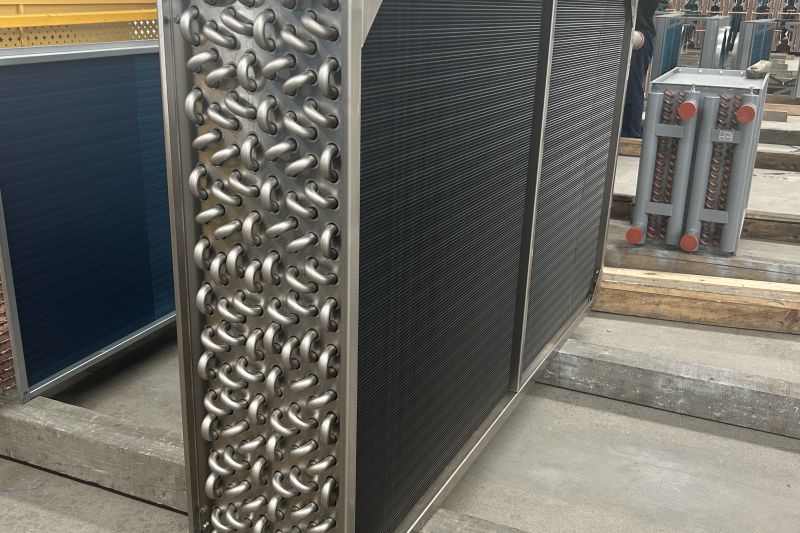
BOYI customized All Stainless Steel surface cooler
Engineered for aggressive industrial atmospheres, this all-stainless surface cooler pairs SS tube with SS fin construction to deliver dependable heat rejection in chemical, food, and high-humidity environments where conventional coils corrode prematurely. Custom dimensions, fin spacing, and connections available.
View Product DetailsBoyi Cooling's Multi-Material Manufacturing Capabilities
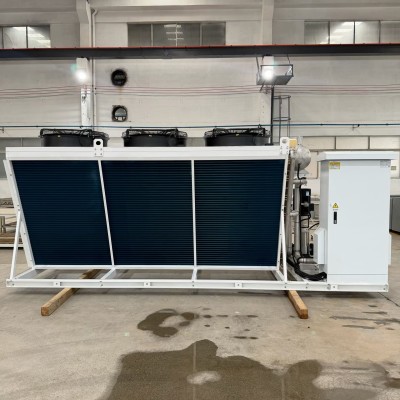
Few manufacturers span the full material spectrum in-house. Boyi Cooling, backed by more than 20 years of heat exchanger manufacturing experience, produces copper-aluminum, all-copper, and all-stainless-steel constructions on the same production campus, supported by electrophoretic coating lines for corrosion-critical projects. That breadth matters: recommendations are driven by the application, not by which material the factory runs most profitably.
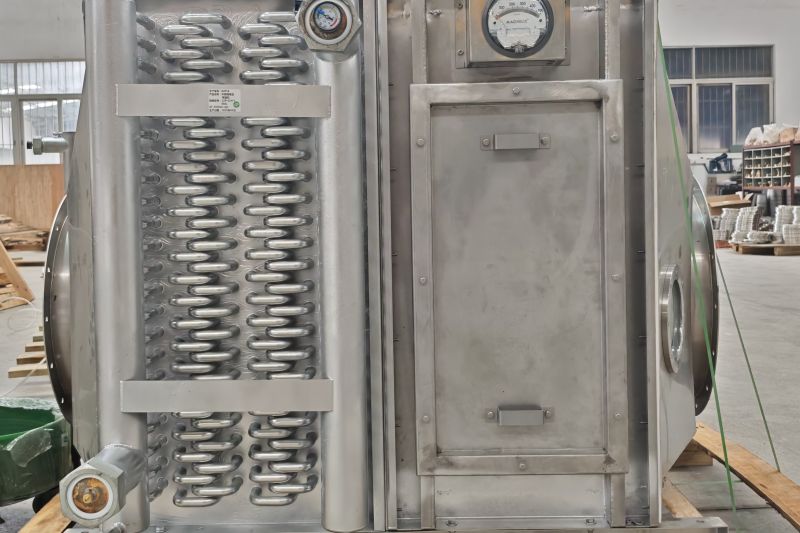
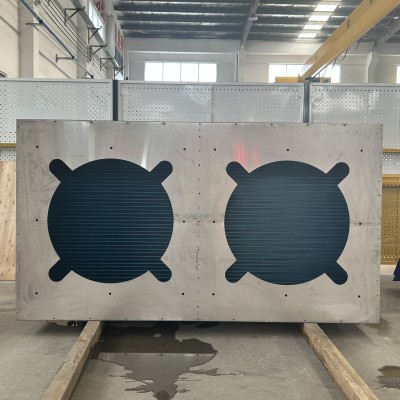
Recent projects illustrate the range. For a European data center operator, Boyi engineered an all-SS V-type dry cooler line with wide-fin sections to survive year-round outdoor exposure. For a chemical processor, the team delivered a customized all-stainless surface cooler — the featured product above — dimensioned to retrofit an existing duct envelope while upgrading the coil from copper to 304 stainless. For greenhouse and HVAC customers, Cu/Al heater-cooler combinations keep budgets lean where the air is clean. Across 30+ export markets the same process applies: review the environment, model the duty, then select the tube-fin-coating combination with the lowest cost per operating year. Buyers who prefer to start from specifications can send their project requirements and receive a customized material proposal within one business day.
The Future: Nanocoatings, Additive Manufacturing, and Bio-Inspired Surfaces
The next material chapter is already visible in laboratories and pilot lines. Superhydrophobic nanocoatings promise condensate management without the durability limits of today's hydrophilic layers. Additive manufacturing is producing latticed exchanger cores with surface-area densities impossible through fin pressing — early demonstrators show 2–4× volumetric heat transfer gains. And bio-inspired textures modeled on shark skin and lotus leaves aim to combine antifouling behavior with enhanced turbulence.
None of these will replace proven tube-fin construction overnight, and buyers should treat them with calibrated optimism: validated performance data, warranty terms, and reference installations matter more than laboratory headlines. What is certain is that the material frontier keeps moving — and manufacturers who invest across coatings, alloys, and forming technologies will keep delivering options that fit each application's true economics.
Frequently Asked Questions
Why choose all-stainless construction over coated copper coils?
Coatings delay corrosion but remain a finite barrier that cleaning or UV can degrade. All-stainless construction removes the failure mode entirely — no galvanic couple, no coating to maintain — making it the lowest-lifecycle-cost choice in chemical, marine, and washdown environments despite a higher initial price.
How much efficiency does stainless steel lose compared with copper?
Thermal conductivity drops roughly 25-fold, but a properly designed coil recovers most of the loss through greater fin surface area, optimized air velocity, and thinner walls. Real-world capacity differences for the same envelope typically land in the 5–15% range — modest against the multi-decade service-life advantage.
When is electrophoretic coating worth specifying?
Whenever copper or aluminum coils face chlorides, industrial fumes, or coastal air and the budget cannot stretch to stainless. E-coating reaches every fin surface uniformly and typically multiplies coil life two- to three-fold in harsh atmospheres — the most cost-effective corrosion insurance for standard constructions.
Key Takeaways
- Material choice balances conductivity, corrosion resistance, strength, and cost — no single metal wins everywhere.
- Copper and aluminum still dominate benign-duty HVAC; carbon steel covers steam and high-pressure duties.
- All-stainless tube-and-fin construction is now standard for chemical, marine, food, and demanding data center cooling duty.
- Electrophoretic and specialty coatings extend standard constructions into corrosive service affordably.
- Match construction to the actual environment — and partner with a manufacturer whose portfolio spans every material family.