IoT and Smart Monitoring in Industrial Heat Exchangers: The Next Frontier
IoT and Smart Monitoring in Industrial Heat Exchangers: The Next Frontier
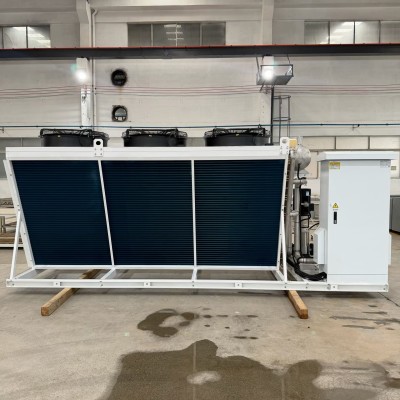
Once silent metal boxes tucked into mechanical rooms, industrial dry coolers are being reinvented as the most data-rich assets on the plant floor. From copper-tube evaporators in pharmaceutical cleanrooms to multi-megawatt V-type dry coolers feeding hyperscale data center cooling loops, every fan, fin, and fluid port is now a candidate for continuous, sensor-based observation.
Drawing on more than twenty years of heat-engineering practice, Boyi Cooling sees the next competitive battleground not in raw heat-transfer surface, but in the intelligence layered on top of it. Smart monitoring turns the dry cooler from a passive heat sink into a self-diagnosing, self-optimizing subsystem that talks fluently to the building management system and to the cloud.
Why Smart Monitoring Has Become a Hard Requirement
Industrial heat exchangers have always been treated as install-and-forget equipment. That assumption is breaking down for three converging reasons.
- Energy cost pressure. Fans, pumps, and compressors account for the majority of an industrial cooling system's electricity bill. Operators no longer accept fixed-speed operation when a variable-speed fan dry cooler with EC motors can deliver measurable savings.
- Process uptime. A single unplanned shutdown of a process cooling loop can cost a data center, chemical plant, or food processor more in lost production than the entire heat exchanger fleet is worth.
- Regulatory and ESG reporting. Sustainability disclosures now demand verifiable, time-stamped data on energy, water, and refrigerant use, not annual estimates.
IoT is the lowest-cost way to convert a dumb cooler into an instrumented asset. Once a stream of high-resolution operating data is available, almost every downstream discipline — predictive maintenance, energy optimization, carbon accounting, remote service — becomes tractable.
The IoT Sensor Stack Inside a Modern Dry Cooler
A well-instrumented heat exchanger from Boyi Cooling is wired with multiple sensor families, each addressing a specific failure mode or optimization lever. None of these sensors is exotic; what is new is the discipline of deploying all of them at once and treating the data as a system, not as isolated alarms.
Temperature
PT100 / PT1000 RTDs at fluid inlet and outlet, plus bearing temperature sensors on each fan motor. Differential temperature is the most direct indicator of heat-transfer health.
Pressure & Flow
Pressure transducers on the process loop and differential pressure switches across the fin pack expose fouling, air binding, and pump degradation in real time.
Vibration
Triaxial accelerometers on fan housings and motor bearings. Vibration spectrum analysis catches imbalance and bearing race wear months before catastrophic failure.
Ambient
Outside air temperature, relative humidity, and wet-bulb. Ambient data lets the controller predict free-cooling hours and switch operating modes proactively.
Sampling rates typically range from one hertz for ambient and process variables to ten kilohertz for vibration. The key engineering decision is local edge processing: raw data is filtered, fouled, and reduced on the cooler itself, while only KPIs and events are pushed up to the cloud.
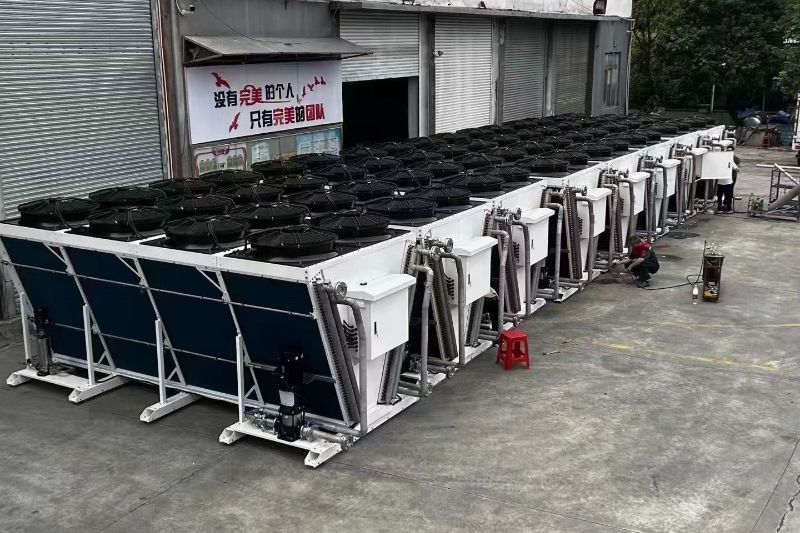
A 1000KW stainless-steel dry cooler in a mining-farm installation, the kind of asset that benefits most from continuous vibration and differential-pressure monitoring.
Real-Time Dashboards and Remote Alerts
Sensors without a usable interface produce noise, not insight. The second layer of an IoT-enabled heat exchanger is the human-machine interface, and it is here that most installations still fall short.
Boyi Cooling ships its connected dry coolers with a web-based dashboard that exposes the same information to operators on the plant floor, to reliability engineers in the head office, and to service technicians in the field. Three principles guide the dashboard design.
- Single-pane-of-glass. Every connected asset appears in one fleet view with consistent units, alarms, and color coding.
- Trend first, alarm second. Historical trending surfaces degradation patterns that threshold-based alarms miss.
- Mobile-first alerting. Push notifications escalate only actionable events, with clear severity, asset ID, and recommended next step.
Practical Insight
Most operators we work with report that the first six months of an IoT monitoring program surface at least one asset that is operating dramatically outside its design point — often a partially closed isolation valve, a fouled fin pack, or a VFD that was never re-tuned after a load change. The monitoring system pays for itself before any predictive algorithm runs.
Predictive Maintenance: From Reactive to Anticipated
Predictive maintenance is the highest-leverage application of heat-exchanger IoT data, and the one where the financial case is easiest to defend. A single unscheduled outage of a mission-critical cooling loop can cost a customer hundreds of thousands of dollars in lost product or service-level penalties.
The workflow has three layers.
- Baseline modelling. Each asset learns its own normal behavior from the first weeks of operation, including seasonal variation. Thresholds are then personalized rather than generic.
- Anomaly detection. Statistical and machine-learning models flag deviations from baseline — rising bearing vibration, drifting approach temperature, slowly climbing motor current.
- Work-order generation. When an anomaly is confirmed, the system creates a maintenance work order with the recommended spares, estimated time-to-failure, and the specific procedure to follow.
In a recent deployment, a regional data center operator identified a failing fan bearing on a 2.5MW dry cooler four weeks before the scheduled overhaul, avoiding an unplanned shutdown.
Variable-Speed Fan Control and EC Motor Integration
IoT delivers the most value when it can also act, not only observe. The clearest example is variable-speed fan control, where the same controller that monitors the asset can also optimize its output.
Traditional AC fan motors run at fixed speed. Electronically commutated (EC) motors, by contrast, can vary their speed continuously over a 10–100% range, allowing the controller to match airflow to actual load. The combination delivers three compounding benefits.
- Energy savings of up to 30% compared with fixed-speed fan operation, especially during part-load conditions and cooler ambient hours.
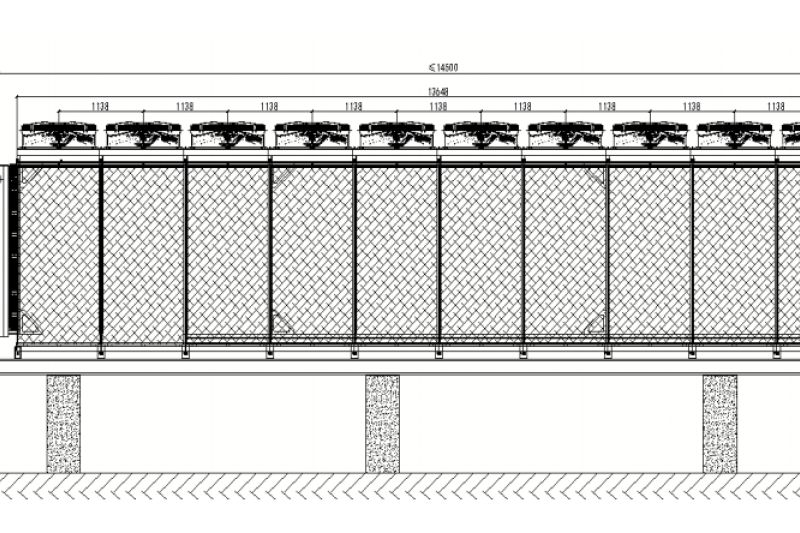
A 2500KW V-type dry cooler equipped with EC fans and integrated IoT controllers, the typical platform for variable-speed load matching.
- Lower acoustic signature. Night-time and shoulder-season operation is dramatically quieter, simplifying permitting in noise-sensitive sites.
- Extended fan bearing life. Lower average speed means lower average load on bearings and windings, and the IoT layer schedules lubrication based on actual running hours.
The control loop is straightforward: the controller reads process temperature, ambient temperature, and load current, then finds the lowest fan speed that maintains the setpoint every five seconds.
BMS Integration: Modbus, BACnet, and Beyond
An IoT-enabled heat exchanger is only as useful as its ability to communicate with the rest of the facility. Boyi Cooling ships its connected dry coolers with native support for the two protocols that dominate building automation: Modbus TCP/RTU and BACnet/IP.
This makes the cooler a first-class citizen of the building management system (BMS), with all operating data, alarms, and setpoints exposed on the same network as air-handling units, chillers, and pumps. Operators can then use the BMS dashboard they already trust, and a single graphics standard applies across the entire mechanical system.
Modbus TCP / RTU
The de-facto standard for industrial controllers. Modbus is simple, deterministic, and supported by every modern BMS, SCADA, and PLC. Use it for high-density register-based telemetry.
BACnet/IP
The dominant protocol for HVAC-specific applications. BACnet objects expose not only the number but also its engineering meaning, units, and alarming metadata, which speeds commissioning.
MQTT & REST
For cloud and IIoT integrations, MQTT publish/subscribe and REST APIs deliver the same telemetry to enterprise historians, analytics platforms, and digital-twin environments.
Cybersecurity
TLS-encrypted links, role-based access, signed firmware, and VLAN segmentation are baseline.
Compatibility Checklist
Before commissioning a connected dry cooler, confirm that the BMS integrator has tested the device against your site's existing front-end. A four-hour integration test on a bench saves a four-day troubleshooting exercise on a rooftop.
Energy Optimization Algorithms in Practice
Smart monitoring data without optimization logic is just telemetry. The third layer of an IoT heat-exchanger program is the algorithm that turns sensor data into lower kWh.
Modern optimization routines combine rule-based logic with a thin layer of machine learning.
Free-Cooling Maximization
When ambient wet-bulb permits, the controller holds the dry cooler in pure-air mode and throttles fans to the lowest stable speed. When conditions drift, the controller pre-positions the system before the setpoint is breached.
Load-Matching
Multiple dry coolers in a common loop coordinate their fan speeds via a shared load signal, avoiding the inefficiency of one unit at full speed while another is at idle.
Adiabatic Pre-Cooling
On hot, dry days, the controller wets the fin pack only for as long as needed to keep the dry cooler inside its design envelope, and only on the banks that actually need it.
Carbon-Aware Control
Where grid carbon intensity is published in real time, the controller can shift cooling work into lower-carbon hours — effectively turning the dry cooler fleet into a demand-response asset.
Across the installed base, these routines deliver average energy savings in the 18–30% range compared with fixed-speed, fixed-setpoint operation. In the most aggressive sites the savings exceed 35%.
Market Trajectory: Where Smart Monitoring Is Heading
The IoT-enabled dry cooler segment is growing at a compounded annual rate well above the broader industrial cooling market. Industry observers track double-digit annual adoption growth, driven by the falling cost of sensors and connectivity, the maturation of edge-compute platforms, and the operational pressure to demonstrate energy and water reductions.
Three structural shifts are worth watching.
- Cooler-as-a-service. Customers increasingly prefer outcome-based contracts where the cooler, sensors, and analytics are bundled. Contact our engineering team for a tailored proposal.
- Digital twin integration. Each physical cooler ships with a living digital twin, updated in real time from the same sensor stream. Commissioning, what-if studies, and operator training happen against the twin, not the asset.
- AI-driven anomaly attribution. Next-generation analytics move beyond “something is wrong” to “the most likely root cause is X, with confidence Y, and the recommended action is Z.”
What Boyi Cooling Ships as Standard
For two decades, Boyi Cooling has supplied industrial dry coolers to customers in more than thirty countries. Smart monitoring is built into every connected unit we ship.
Native Connectivity
Every connected dry cooler ships with Modbus TCP, BACnet/IP, and MQTT pre-configured, with a documented register map and a tested BMS integration profile.
Variable-Speed Fans
EC motors with integrated controllers, optimized for the 10–100% speed range and tuned to the specific fan curve and acoustic envelope of each cooler.
Cloud Dashboard
Fleet-wide visibility with role-based access, historical trending, alarm management, and mobile push notifications, included for the life of the asset.
Remote Service
Boyi engineers can dial into the asset for commissioning support, performance tuning, and post-installation optimization, anywhere in the world with a stable link.
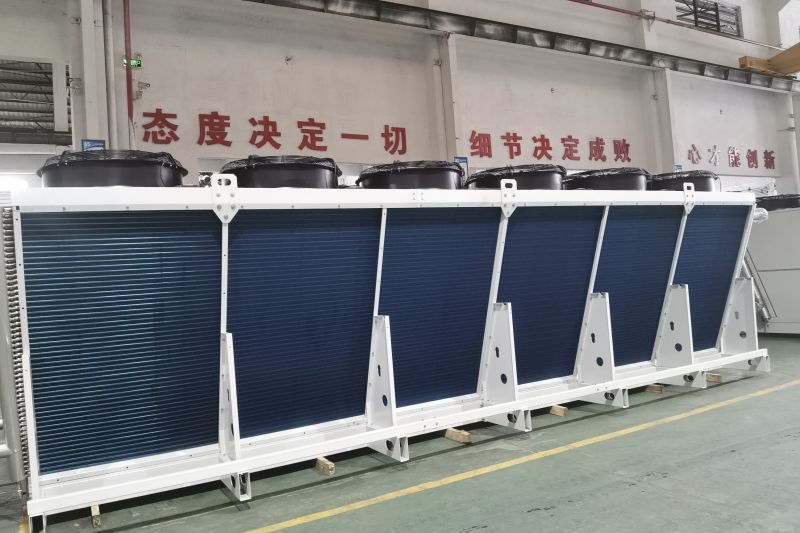
High Efficiency V-Type Dry Cooler with Copper Tube & Aluminum Fin
A field-proven V-type platform that pairs energy-efficient fin geometry with the EC fan, sensor stack, and BMS connectivity needed to deploy IoT monitoring at scale. Customizable from sub-100KW modules to multi-megawatt banks, and export-ready to mining, chemical, food & beverage, and data center sites in more than thirty countries.
View Product DetailsA 90-Day Plan to Roll Out Smart Monitoring
For operators ready to begin, the following phased plan reduces risk and produces measurable savings inside the first quarter.
- Days 0–15 — Baseline. Instrument two or three high-criticality dry coolers with the sensor stack described above. Capture baseline energy, approach temperature, and fan operating profile.
- Days 15–45 — Tune. Verify the BMS integration, alarm thresholds, and dashboards. Hand over to operations and start collecting structured service feedback.
- Days 45–90 — Optimize. Enable variable-speed fan control and the energy-optimization routines. Track kWh savings against the baseline and document the operating envelope.
- Day 90 onward — Scale. Roll out to the remaining fleet using the standardized register map, dashboard templates, and commissioning procedures proven on the pilot.
Frequently Asked Questions
Do I need to replace my existing dry coolers to add monitoring?
Not necessarily. Boyi Cooling offers retrofit sensor kits and edge gateways designed for the most common installed bases. A retrofit typically adds 5–10% to the asset's performance for 1–2% of its replacement cost, and reuses existing cabling where possible.
Is IoT monitoring worth it for a single small cooler?
For a single low-criticality unit the answer is usually no — a routine inspection schedule is more cost-effective. The economic case flips decisively when the cooler is part of a process whose downtime is expensive, or when there are at least three units in similar service that can share a single dashboard.
What cybersecurity protections are built in?
TLS-encrypted links, signed firmware, role-based access, network segmentation guidance, and an option for on-premises-only deployments. The cybersecurity posture is documented in the standard operating manual and reviewed against IEC 62443.
How long does commissioning take?
A typical connected dry cooler commissions in half a day once the BMS integrator has the documentation. Larger fleets with shared dashboards typically run a one- to two-week staged commissioning window to keep production online throughout.
Closing Thoughts
The heat exchanger of the next decade looks nothing like the heat exchanger of the last. The metal is broadly the same; the value sits on top of it. Send our team a short inquiry with your process duty, ambient conditions, and current pain points, and we will show you what a connected dry cooler could do for your specific site.