Immersion Cooling vs. Dry Cooling: Comparing Next-Gen Data Center Cooling Approaches
High-density computing has pushed data center thermal design into unfamiliar territory. As rack densities climb from 15 kW toward 50 kW and beyond, facility teams are re-evaluating every option — including immersion cooling, once confined to niche HPC labs. Yet despite the headlines, dry cooling remains the backbone of global data center heat rejection. This guide compares the two approaches honestly: where each wins, where each struggles, and why the most practical future for many operators is a hybrid architecture in which a liquid-cooled or immersion front-end discharges its heat through a dry cooler back-end.
1. The Cooling Landscape for High-Density Data Centers
Data center cooling was traditionally dominated by chilled-water CRAH units and computer room air conditioners — a model that worked well when racks drew 5–10 kW. Modern AI training clusters and GPU superpods routinely exceed 30–50 kW per rack, and some liquid-cooled designs target 100 kW or more. At these densities, moving heat with air alone becomes expensive and spatially inefficient.
The industry response has split into two camps. One moves the coolant directly to the silicon — through cold plates, rear-door heat exchangers, or full immersion in dielectric fluid. The other keeps proven air-side infrastructure but makes it far more efficient with economizers, EC fan walls, and closed-loop dry coolers that reject heat without water. Both camps are valid; the right answer depends on workload density, budget, climate, and operational maturity.
It is also worth noting that these camps are less opposed than they first appear. Even a fully immersed server generates heat that must leave the building: the dielectric fluid picks up heat in the tank, and in nearly every commercial immersion deployment that heat is rejected outdoors by a dry cooler. Understanding both technologies, rather than treating them as rivals, is the mark of a well-prepared buyer.
2. Immersion Cooling Overview: How It Works
Immersion cooling submerges IT hardware directly in a thermally conductive but electrically non-conductive (dielectric) liquid. Because the fluid contacts components directly, heat transfer coefficients far exceed what air can achieve, while fan noise, dust, and altitude derating essentially disappear.
Single-Phase Immersion
In single-phase immersion, servers sit in tanks of synthetic or mineral dielectric oil, and the fluid is continuously circulated through liquid-to-liquid heat exchangers. The fluid never boils; it simply absorbs heat and carries it away. Single-phase systems are mechanically simple, use relatively inexpensive fluids, and can often retrofit standard servers with fan removal and material compatibility checks. Typical rack-level densities reach 50–100 kW.
Two-Phase Immersion
Two-phase immersion uses engineered fluids with low boiling points (around 50–60°C). Processor heat makes the fluid boil; the vapor rises, condenses on a water-cooled condenser coil at the top of the tank, and drips back down. The latent heat of vaporization makes two-phase systems extremely effective at absorbing high heat fluxes with minimal fluid flow. The trade-offs are higher fluid cost, careful fluid management, and condenser engineering that becomes the system's critical bottleneck.
In both variants, the tank's heat exchange loop ultimately needs a destination for its heat. Whether the loop runs at 40°C or 55°C, that warm fluid must be cooled before returning to the tanks — and that is where the outdoor heat rejection technology decides the project's economics.
3. Dry Cooling Overview: The Proven Back-End
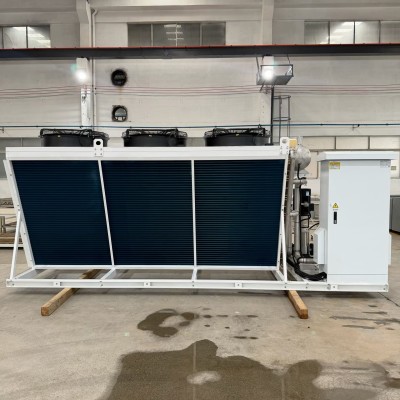
A dry cooler is a closed-loop fluid-to-air heat exchanger. Warm process fluid — typically a water/glycol mixture or the immersion tank's own coolant loop — is pumped through finned tube coils while axial fans draw ambient air across the fin surface. Heat transfers from fluid to air with no water consumption, no chemical treatment, and no Legionella risk. When outdoor temperature sits below the loop temperature, the system runs in pure free-cooling mode with compressors off, delivering some of the lowest operating costs in the industry.
Key strengths of the dry cooler architecture include:
- Zero water use: No evaporation, no blowdown, no water treatment chemistry — critical in water-stressed regions and for ESG reporting.
- Free cooling potential: In most temperate climates, a properly sized dry cooler provides 70–95% of annual cooling through economizer hours alone.
- Proven reliability: Decades of field deployment in power plants, industrial process cooling, and telecom infrastructure.
- Simple integration: Any liquid loop at 35–60°C — including immersion tank loops and rear-door loops — connects to a dry cooler with standard hydronic components.
- Low maintenance complexity: Seasonal coil cleaning, fan bearing checks, and glycol monitoring cover most of the service scope.
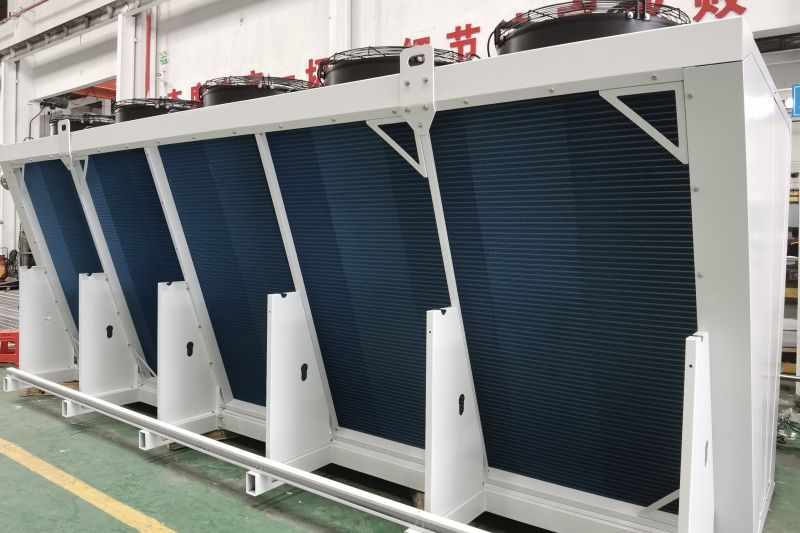
A V-type dry cooler serving a closed-loop process circuit — the same architecture used as the heat rejection back-end for immersion systems.
The limitations are equally clear. A dry cooler can only cool fluid to a few degrees above ambient air temperature, so loop temperatures float with the weather, and heat rejection per unit of plot area is lower than evaporative systems. Above roughly 50 kW per rack, distributing enough air inside the white space becomes impractical — which is why liquid capture at the rack combined with dry cooler rejection has become the dominant high-density pattern.
4. Head-to-Head Comparison Matrix
The table below compares the two approaches across the criteria that matter most in procurement decisions. Figures are representative ranges for a mid-sized facility in a temperate climate and will vary with climate, design temperatures, and workload profile.
| Criterion | Immersion Cooling | Dry Cooling (Air-Side / Liquid Loop) |
|---|---|---|
| Max rack density | 50–200+ kW per tank/rack | 15–40 kW air-side; higher with liquid capture |
| Typical PUE contribution | Very low (1.02–1.10 achievable) | 1.1–1.3 with free cooling; higher in hot climates |
| Water usage | None at the rack; depends on back-end | Zero (true dry operation) |
| Capital cost | High: tanks, fluids, floor loading, server mods | Moderate: standard hydronics + air-side equipment |
| Operating cost | Low fan/pump energy; fluid top-up costs | Low with free cooling; fan energy on peak days |
| Maintenance complexity | Specialist skill: fluid handling, tank servicing | Well-known mechanical trades; seasonal coil cleaning |
| Retrofit feasibility | Difficult: floor loading, logistics, server prep | High: rooftop/slipbasin placement, standard interfaces |
| Ecosystem maturity | Emerging; limited vendor pool | Mature; global supplier base |
Two rows deserve emphasis. First, "water usage: depends on back-end" for immersion is the central design decision: a tank paired with an evaporative cooling tower inherits the water and Legionella liabilities the immersion layer was meant to escape, while a dry cooler keeps the entire chain waterless. Second, retrofit feasibility explains most real-world adoption — operators with live facilities choose architectures that do not require draining tanks of oil through their data hall.
5. Where Immersion Cooling Wins
Immersion cooling is the right answer in specific, well-defined scenarios — and pretending otherwise serves no one. It wins when:
- Extreme per-rack density is non-negotiable. AI training pods, crypto mining at maximum hash density, and some HPC workloads exceed what even rear-door liquid capture can handle; immersion removes the air-side constraint entirely.
- Noise and environmental control matter. Fanless tanks simplify acoustic design and eliminate airflow-related contamination — valuable in harsh or dusty sites.
- Uniform temperatures extend hardware life. Components sit at near-constant temperature with no hotspots, which some operators report reduces failure rates on memory and power delivery.
- Heat reuse is a design goal. Immersion loops exit at consistently high temperatures (45–60°C), making district heating or process heat reuse far more practical than with low-grade air heat.
The honest caveats: fluid cost and compatibility engineering are significant, server OEM warranty conversations must be resolved before purchase, and the operating talent pool is still thin. Buyers should also scrutinize the total loop — a brilliant immersion tank bolted to a thirsty cooling tower is not a water-positive design.
6. Where Dry Cooling Wins
For the majority of data centers — and for the outdoor half of nearly every liquid-cooled facility — dry cooling remains the strongest choice. It wins when:
- Scalability and speed matter. Modular dry cooler banks stage to match IT load growth, craned onto roofs or slipbasins without interrupting operations.
- Water is scarce or expensive. A true dry system uses zero water year-round, sidestepping drought restrictions and water utility escalation.
- Free cooling economics dominate. In climates with more than ~2,500 economizer hours per year, compressor-free operation cuts cooling energy by 60–90% versus mechanical chilled-water plants.
- Operational simplicity is valued. Any competent mechanical contractor can service finned coils, EC fans, and glycol loops; no specialist fluid chemistry is required.
- Budget discipline applies. Capital cost per kW of heat rejection is dramatically lower than immersion infrastructure, with payback driven by bankable energy models.
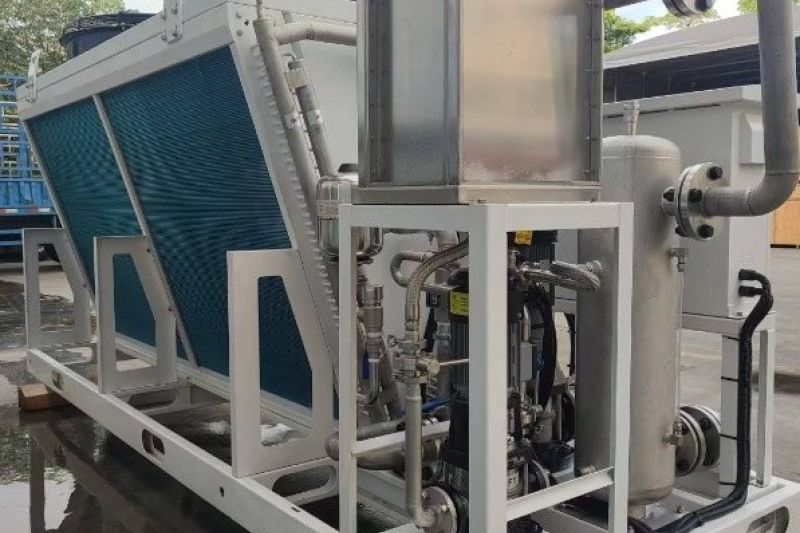
V-form air-cooled heat rejection: compact footprint, staged fan control, and zero water consumption make dry coolers the default outdoor choice.
7. The Hybrid Future: Immersion Front-End, Dry Cooler Back-End
The most successful high-density designs increasingly refuse to pick a side: they capture heat with liquid at the rack — cold plates or immersion tanks — and reject it to the atmosphere with dry coolers engineered for warm-loop operation. This split plays to each technology's strength:
- Front-end: Liquid capture handles densities air cannot, with tight temperature control at the silicon.
- Back-end: The dry cooler rejects heat waterlessly and, for most of the year, with compressors off.
- Design temperature: Warm-water loops of 40–55°C extend free-cooling hours dramatically — a 50°C loop free-cools even on a 45°C day, where an 18°C chilled-water loop would need mechanical cooling.
- Resilience: Approach temperature margins, adiabatic assist, or oversize fan stages cover extreme ambient events.
This split architecture is why leading immersion vendors ship their tanks with liquid-to-liquid CDUs and specify dry fluid coolers as the standard companion product. The technologies are complementary by design, not competitive in practice.
8. Boyi Cooling's Role: Engineering the Heat Rejection Back-End
With 20+ years of thermal engineering experience and custom manufacturing spanning copper-tube, stainless-steel-tube, and mixed-material coil construction, Boyi Cooling builds the dry cooler side of this hybrid equation. Our V-type and flat-type dry coolers are engineered project-by-project: loop temperatures, glycol concentration, ambient design conditions, noise limits, and footprint constraints all feed the thermal selection before a single fin is pressed. Units ship to more than 30 countries, from 60 kW chemical-industry coolers to multi-megawatt data center installations.
A representative free-cooling case: an operator running a warm-water loop at 45°C supply needed heat rejection that held full capacity through summer peaks while spending most of the year compressor-free. Boyi engineered a stainless-steel-tube V-type dry cooler with EC fan staging and an extended-surface fin coil selected for the exact 45°C operating point. The result: zero water consumption, mechanical cooling reserved for the hottest few hundred hours per year, and a back-end ready for denser IT loads as liquid capture evolves.
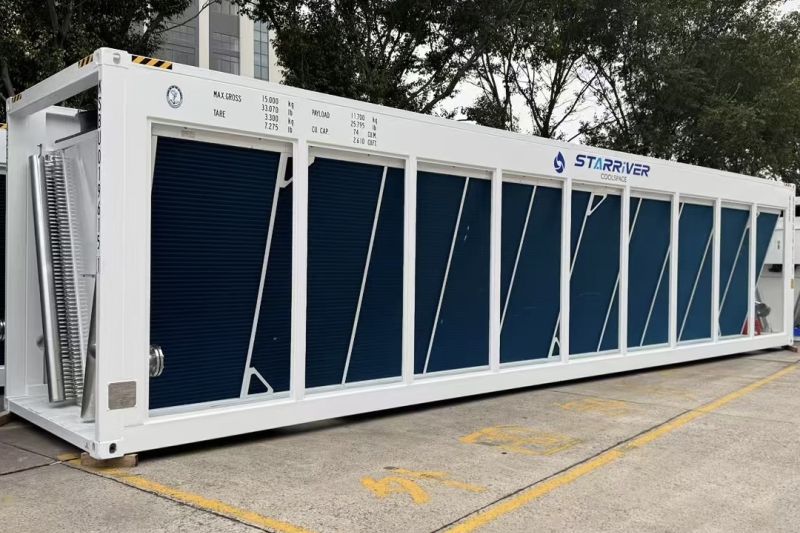
Featured Dry Cooler
1100KW Stainless Steel Tube V-type Dry Cooler for Chemical Industry
Boyi Customized 1100KW Stainless Steel Tube V-type Dry Cooler for Chemical Industry — all-stainless coil, EC fan staging, engineered for warm-loop free cooling and waterless heat rejection.
View Product DetailsBecause every liquid-cooled facility eventually needs an outdoor heat exchanger, buyers evaluating immersion systems should qualify their dry cooler supplier with the same rigor as the tank vendor: thermal selection methodology, coil material options for corrosive sites, part-load fan energy data, and structural design for the installation envelope. Review Boyi Cooling's full dry cooler and heat exchanger product range or learn more about our 20+ years of custom thermal manufacturing experience.
9. Market Reality: Why Dry Cooling Stays Dominant
Immersion cooling generates headlines; dry cooling generates buildings. Analysts consistently place air-side and liquid-loop cooling above 70–80% of installed data center heat rejection capacity for the next five years, and the reasons are structural:
- Installed base inertia: Thousands of operating facilities are built around air-side and hydronic infrastructure, upgraded incrementally rather than replaced.
- Server ecosystem: Most servers still ship with air-cooling assumptions, and liquid-ready hardware carries cost premiums and warranty conditions.
- Cost and risk: Dry cooling is fully de-risked technology with commodity service networks; immersion remains a specialist deployment.
- Flexibility: Facilities serving mixed workloads need architectures that tolerate 5 kW racks today and 40 kW racks in five years — staged dry cooler banks with liquid-ready loops provide exactly that path.
The practical takeaway is not "immersion versus dry cooling" but "which combination fits my density roadmap." Facilities planning liquid capture within three years should specify warm-loop-capable dry coolers with EC fan control now, so the outdoor plant is already optimized when the tanks arrive.
Planning a High-Density Build or Retrofit?
Boyi Cooling engineers custom V-type and flat-type dry coolers for data center, mining, chemical, and industrial process applications — 60 kW to multi-megawatt, copper or all-stainless construction, with free-cooling optimized control. Send us your loop temperatures and site conditions for a tailored thermal selection.
Request a Custom Dry Cooler Quote Contact Our Engineering TeamFrequently Asked Questions
Can a dry cooler cool an immersion tank directly?
Yes. In warm climates many single-phase immersion systems run the tank fluid loop directly to a dry fluid cooler. Where loop temperature must be held tightly, a liquid-to-liquid CDU isolates the tank loop from an intermediate glycol loop serving the dry cooler. Both arrangements are fully waterless.
Is immersion cooling more energy efficient than dry cooling?
They are not alternatives at the same layer. Immersion improves heat capture at the rack; the dry cooler determines how efficiently heat leaves the building. A hybrid — liquid capture plus a free-cooling dry cooler — typically beats either technology alone on total facility energy.
How do I size a dry cooler for a future liquid-cooled retrofit?
Size for the projected peak heat rejection at your warm-loop design temperature, stage fan capacity for part-load efficiency, and reserve hydraulic interfaces for the CDU loop. Sharing your density roadmap with the manufacturer early via our inquiry page avoids re-purchasing the plant later.