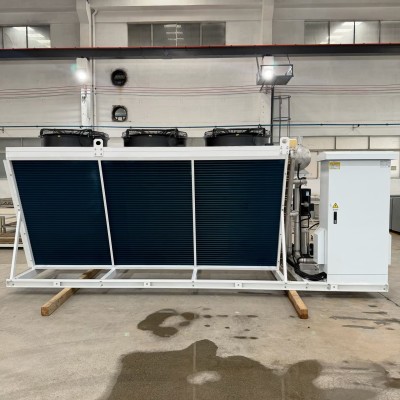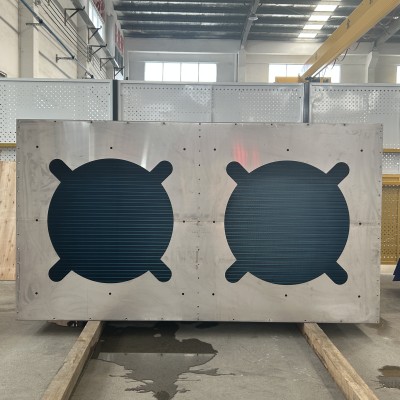
Evaporator Coils: Function, Design Principles, and Maintenance Best Practices
In any vapor-compression refrigeration system, the evaporator coil is where cooling actually happens. While compressors and condensers get most of the attention, it is the evaporator that absorbs heat from the air or liquid being cooled and moves it into the refrigerant loop. Whether the application is a data center dry cooler loop, a cold storage warehouse, or a rooftop air conditioning system, evaporator performance directly determines system capacity, energy efficiency, and equipment lifespan.
Boyi Cooling has manufactured custom evaporator coils and heat exchangers for more than 20 years, exporting to over 30 countries across North America, Europe, the Middle East, and Southeast Asia. In this guide, we explain how evaporator coils work, how they are configured, why all-copper construction matters, and which maintenance practices keep them running reliably for decades.
How Evaporator Coils Work: The Four-Stage Cycle
An evaporator coil operates on a simple thermodynamic principle: a liquid refrigerant under low pressure boils at a temperature below that of the surrounding air. When warm air passes over the coil surface, heat flows into the refrigerant, causing it to evaporate. This phase change absorbs a large amount of energy — the latent heat of vaporization — which is what produces the cooling effect.
The process inside the coil can be broken into four stages:
1. Expansion
High-pressure liquid refrigerant passes through an expansion valve, dropping sharply in pressure and temperature. It enters the evaporator as a cold, low-pressure mixture of liquid and vapor.
2. Heat Absorption
Warm air is drawn across the finned coil surface. Heat transfers through the fins and tube walls into the refrigerant, cooling the air by 10–15°C in a typical HVAC application.
3. Evaporation
The liquid fraction of the refrigerant boils off, converting to saturated vapor. Coil circuits are designed so the refrigerant is fully evaporated before it reaches the outlet.
4. Superheat
The vapor continues to absorb a small amount of heat, rising above its saturation temperature. Controlled superheat protects the compressor from liquid slugging.
Because the cooling capacity of an evaporator depends on this phase change rather than on a simple temperature difference, coil design decisions — tube diameter, circuiting, fin geometry, and face velocity — all influence how efficiently the two-phase process completes inside the available surface area. Buyers evaluating an evaporator coil or heat exchanger should always request capacity data at their actual design conditions, not just nominal ratings.
Coil Configurations: U-Type, L-Type, and Flat-Type
Evaporator coils are fabricated in several geometric configurations, each suited to different airflow paths, installation envelopes, and drainage requirements. The three most common designs in industrial and commercial use are:
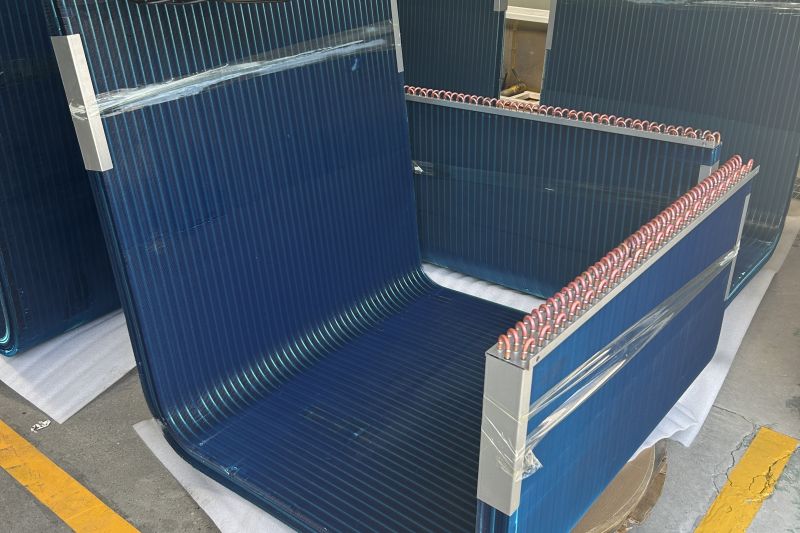
U-Type
Tubes are bent into a U shape so both refrigerant connections exit on the same end sheet. This simplifies piping and header arrangement, makes cleaning and leak repair easier, and allows the coil to be fully drainable. U-type coils are the standard choice for air handling units and condensing units.
L-Type
An L-shaped coil wraps around a corner of the unit casing, increasing surface area within a compact footprint. Common in refrigeration cabinets and tight equipment rooms where a straight coil cannot fit.
Flat-Type
Straight tubes with return bends in headers, ideal for high-volume airflow with low pressure drop. Frequently used in process cooling and large industrial air streams.
Drain pan design is inseparable from coil configuration. During cooling operation, moisture condenses on the coil surface and must be captured and removed. A well-designed pan slopes toward the drain connection, sits below the lowest tube row without interfering with airflow, and is sized so condensate never overflows even at peak latent load. Poor drain pan design is one of the most common causes of water damage, biological growth, and downstream corrosion in HVAC equipment.
All-Copper Evaporators: Durability by Design
Material selection is the single most consequential decision in evaporator coil design. The industry default is copper tubes with aluminum fins, which balances cost and thermal performance. However, for corrosive environments — coastal installations, industrial plants, and systems with aggressive air quality — all-copper construction (copper tube with copper fin) offers a decisive advantage.
Copper naturally forms a protective oxide layer that resists atmospheric corrosion far better than aluminum. In pitting-prone coastal air or chemically loaded industrial atmospheres, aluminum fins can degrade within a few years, while all-copper coils routinely deliver service lives two to three times longer. Copper also offers approximately 60% higher thermal conductivity than aluminum, slightly improving heat transfer per unit area, and its formability allows fin collars to be drawn tight around the tube, minimizing contact resistance.
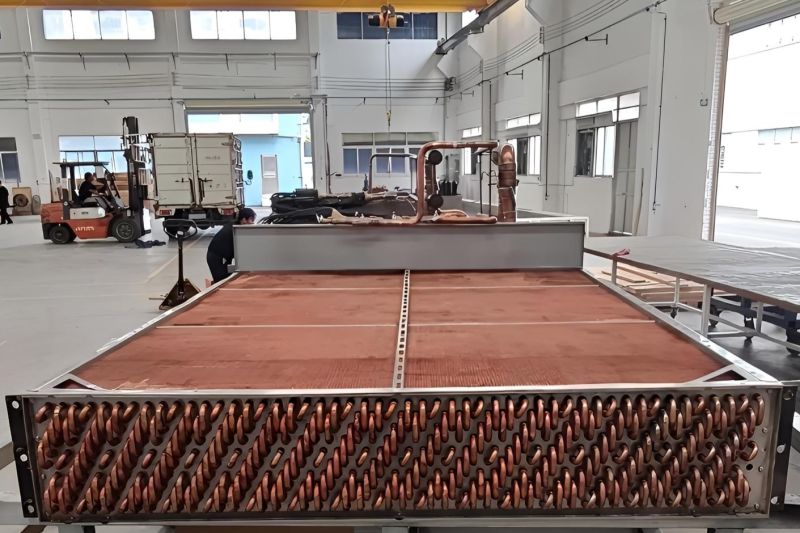
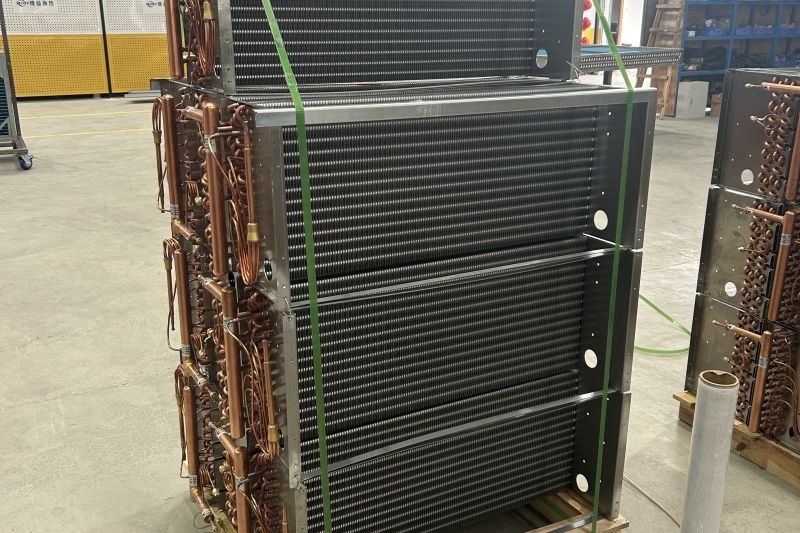
All Copper Finned Tube Evaporator Coil for Air Conditioning Systems
An all copper tube and copper fin evaporator is a key HVAC component, offering excellent corrosion resistance and durability for demanding air conditioning installations.
View Product DetailsBoyi Cooling manufactures U-type all-copper evaporator coils and fully copper-finned designs for air conditioning systems, cold storage, and process cooling, with tube diameters and circuiting customized to each project's refrigerant and capacity requirements.
Frost and Defrost Management
In low-temperature applications — cold storage rooms, freeze-drying processes, outdoor equipment below 4°C — moisture in the airstream freezes on the coil surface instead of draining away. Frost accumulation blocks airflow, insulates the heat transfer surface, and can collapse aluminum fins if left unmanaged. Managing frost is therefore a core design and operating concern.
Effective frost management combines several strategies. Wider fin spacing (6–10 mm instead of the 2–3 mm used in comfort cooling) delays blockage and allows frost to accumulate longer before defrosting is needed. Larger coil face area at lower air velocity slows frost formation. Defrost methods include off-cycle defrost using ambient or product load heat, hot gas defrost which routes compressor discharge through the coil for fast clearing, and electric defrost with embedded heaters. The right choice depends on application temperature, energy cost, and how quickly the room must return to setpoint after defrost.
For operators, the practical rule is: schedule defrost based on measured coil performance — a rising temperature difference across the coil or a falling saturated suction temperature signals frost buildup, even if the timer says otherwise.
Airflow Design: Counter-Flow vs. Cross-Flow
The relative direction of air and refrigerant flow through the coil affects the temperature profile along its length and, with it, heat transfer efficiency.
| Aspect | Counter-Flow Arrangement | Cross-Flow Arrangement |
|---|---|---|
| Flow geometry | Air and refrigerant travel in opposite directions | Air crosses the refrigerant path at 90° |
| Temperature profile | Coldest air meets coldest refrigerant; most even ΔT distribution | Uneven ΔT across the coil face |
| Approach temperature | Lowest achievable air outlet temperature | Higher approach temperature for the same surface |
| Manufacturing simplicity | More complex circuiting and header work | Simpler, lower cost, easier to scale rows |
| Typical use | Low-temperature refrigeration, tight approach requirements | Comfort HVAC, general process cooling |
In counter-flow coils, the exiting air meets the coldest incoming refrigerant, which allows the air to be cooled closer to the refrigerant temperature — a meaningful advantage when a low supply air temperature is the design target. Cross-flow coils sacrifice some approach performance in exchange for simpler construction and lower pressure drop, which is why most commercial HVAC coils are cross-flow or hybrid arrangements. Face velocity matters as much as direction: keeping air velocity in the 2–3 m/s range for cooling coils limits condensate carryover, while dehumidification duty may require lower velocities.
Maintenance Best Practices
Evaporator coils fail far more often from neglect than from design errors. A structured maintenance routine protects capacity, energy efficiency, and indoor air quality:
Clean Coils Annually
Wash with a mild detergent or commercial coil cleaner from the air-entering side, rinsing in the opposite direction of airflow. Avoid high-pressure washers above 600 psi, which flatten fins and drive dirt deeper.
Replace Filters on Schedule
Clogged filters cause dust to bypass and load onto the coil. Track pressure drop across filters and replace at the manufacturer's limit rather than on a fixed calendar.
Perform Leak Detection
Inspect headers, u-bends, and expansion valve connections seasonally. Electronic leak detectors or bubble solution catch small refrigerant losses before they become capacity failures and compressor risk.
Straighten Bent Fins
Use a fin comb matched to the fins-per-inch count. Flattened or matted fins choke airflow and can cut capacity by 10–20% in affected areas.
Verify Superheat and Drainage
Confirm superheat against the expansion device setting and check that drain pans and trap lines flow freely. Standing water in a pan accelerates corrosion and biological growth.
Log Performance Trends
Record suction pressure, supply air temperature, and ΔT at each visit. Trend data reveals fouling and refrigerant loss long before occupants notice a comfort problem.
Common Failure Modes and Prevention
Understanding how evaporator coils fail helps buyers specify against failure in the first place — and helps operators catch problems early:
| Failure Mode | Root Cause | Prevention Strategy |
|---|---|---|
| Formicary & pitting corrosion | Organic acids and chlorides in indoor air attacking copper | All-copper construction with heavier tube walls; source-control of airborne contaminants; protective coatings where needed |
| Coil freezing | Low refrigerant charge, dirty filters, or failed blower reducing airflow | Maintain correct charge and airflow; install freezestat and suction pressure controls |
| Refrigerant leaks | Vibration fatigue at u-bends, galvanic corrosion at dissimilar joints | Proper support and isolation; brazed joints with nitrogen purge; seasonal leak checks |
| Airflow blockage | Frost, dust loading, fin damage, foreign objects | Filtration, defrost strategy, fin combing, routine visual inspection |
| Drain pan overflow | Clogged drain, poor pan slope, excessive latent load | Trap and slope design review, biocide tablets, condensate overflow switches |
Many of these risks can be engineered out at the specification stage. Working with an experienced heat exchanger manufacturer during design — rather than buying from a catalog afterward — lets the buyer align tube material, fin spacing, circuiting, and casing with the actual operating environment.
Boyi Cooling Evaporator Cases
Boyi Cooling's evaporator portfolio covers the full range of configurations described above, manufactured with 20+ years of thermal engineering experience and backed by custom fabrication capability:
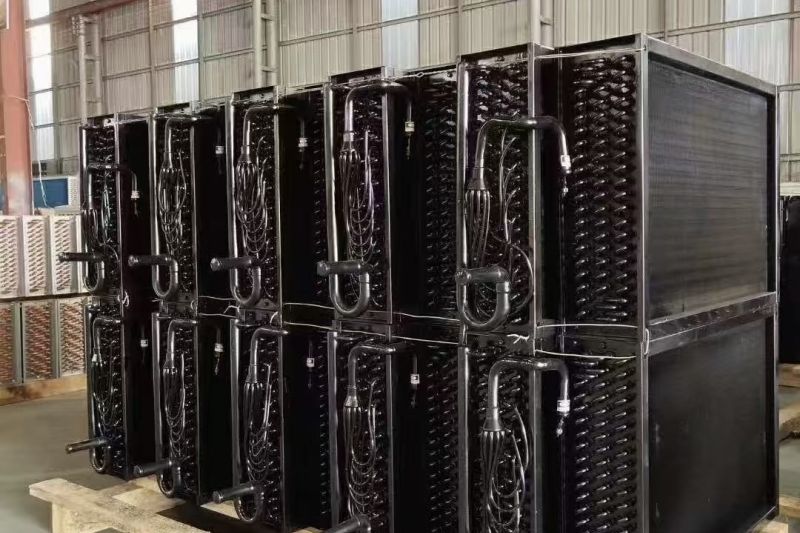
- U-type copper tube evaporator coil — same-end connections for compact AHU installations, fully drainable circuiting, and easy maintenance access. Used across commercial air conditioning and heat pump systems.
- All-copper finned tube evaporator for AC systems — copper tube with copper fin for coastal and corrosive industrial sites, delivering extended service life where aluminum-fin coils degrade prematurely.
- Cold storage evaporator coils — wide fin spacing and hot gas or electric defrost options for below-zero rooms, engineered to match room dimensions and pull-down requirements.
- Custom sizes and circuiting — coils built to customer drawings or performance specifications, from Ø9.52mm small-diameter designs to large industrial blocks, with a 30+ country export track record.
Every Boyi coil is pressure-tested before shipment and can be supplied with matching casing, drain pan, and connection arrangements to drop directly into existing equipment footprints. For projects that also require heat rejection equipment, our dry cooler and condenser product lines complete the full cooling chain from a single supplier.
Frequently Asked Questions
How long should an evaporator coil last?
A well-maintained copper-tube evaporator in a clean indoor environment typically lasts 15–20 years. In corrosive coastal or industrial atmospheres, standard aluminum-fin coils may need replacement in 8–10 years, while all-copper construction can extend this significantly.
Can I mix copper tubes with aluminum fins?
Yes — copper tube/aluminum fin is the industry standard and the most cost-effective combination for most environments. All-copper construction is a premium option justified by corrosive conditions or long service life requirements.
Why is my evaporator coil freezing up?
The most common causes are low airflow (dirty filters, failed blower, blocked ducts) and low refrigerant charge. Both reduce heat absorption and allow coil surface temperature to fall below 0°C, freezing condensate. Fix airflow and charge before anything else.
Key Takeaways
- The evaporator is where cooling happens: refrigerant absorbs heat and evaporates in a four-stage cycle of expansion, heat absorption, evaporation, and superheat.
- U-type, L-type, and flat-type configurations trade piping convenience, footprint, and pressure drop — drain pan design must match the chosen geometry.
- All-copper construction provides superior corrosion resistance for coastal and industrial environments, at a higher initial cost.
- Low-temperature applications need wide fin spacing and a deliberate defrost strategy.
- Annual cleaning, filter discipline, leak detection, and fin maintenance prevent most premature failures.
Need a Custom Evaporator Coil?
Boyi Cooling engineers custom U-type, L-type, and all-copper evaporator coils for air conditioning, cold storage, and industrial process cooling — built to your refrigerant, capacity, and footprint. With 20+ years of manufacturing experience and exports to 30+ countries, we deliver coils that fit your equipment and your environment.
Request a Free Quote Contact Our Engineers