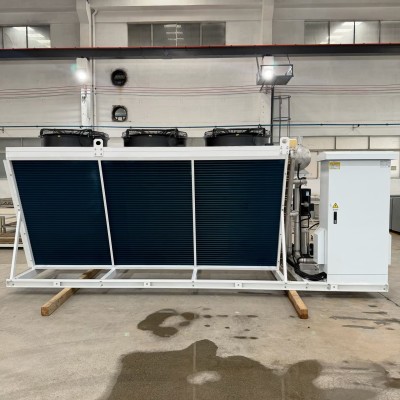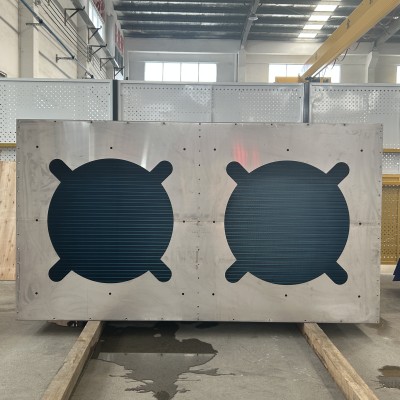


Dry Cooler Performance Testing: Key Metrics and Quality Assurance Methods
Dry Cooler Performance Testing: Key Metrics and Quality Assurance Methods
A dry cooler is only as good as the numbers it delivers on site. Here are the metrics that matter, the tests that verify them, and the documents a buyer should demand before releasing final payment.
Dry cooler performance is verified through four test families: thermal performance (capacity, approach temperature, airside pressure drop, fan power), leak testing (helium mass spectrometry, pressure decay, bubble immersion), structural testing (hydrostatic pressure at 1.5x design pressure plus weld inspection by RT or UT), and acoustic and vibration measurement. A credible supplier issues a serialized report per unit listing measured versus guaranteed values, instrument calibration certificates, and the acceptance criteria applied.
Why Testing Decides the Project
Every dry cooler is sold against a thermal guarantee: a defined duty at a defined ambient temperature, entering fluid temperature, and airflow. When that guarantee is not verified before shipment, the shortfall appears during commissioning, and the buyer owns the problem. Fans run flat out, supply temperatures drift above setpoint, and the remaining remedies are extra coils, larger fans, or a derated load.
Catching a deficiency in the factory costs days. Catching it on site costs months of rework, freight, and lost production. That asymmetry is why independent verification is now a standard condition in contracts for dry cooler equipment, and why serious heat exchanger manufacturers publish test capabilities instead of hiding behind datasheets. A documented record also protects the supplier: it turns a vague argument about site conditions into a factual discussion about measured performance at a stated operating point.
The Five Metrics That Matter
Laboratory reports carry dozens of data points, but five determine whether the unit meets duty in the field.
| Metric | What It Proves | Typical Acceptance |
|---|---|---|
| Heat rejection capacity | Actual kW removed at rated ambient and fluid temperatures | ≥ 100% of guaranteed duty |
| Approach temperature | Gap between leaving fluid temperature and ambient dry-bulb | ≤ design approach + 0.5 K |
| Airside pressure drop | Fan static load and long-term energy consumption | ≤ design value + 5% |
| Fan power | Parasitic electrical load at rated airflow | ≤ nameplate kW per fan |
| Sound power level | Compliance with site noise limits and permits | ≤ guaranteed dB(A) |
Capacity and approach temperature are coupled. A unit can hit its kW figure while missing the approach because it moves more air than specified, so review both together and confirm the conditions behind each figure. A capacity figure without a stated test condition is marketing, not data.
Fan power deserves separate attention because it sets the operating cost profile for the next fifteen years. A coil that is 8% short on surface area can still pass a capacity test at full fan speed, yet it will consume noticeably more electricity for its whole life. In data centers that penalty shows up directly in the data center cooling overhead ratio, where fan energy is part of what the facility must justify.
Thermal Performance Testing Methods
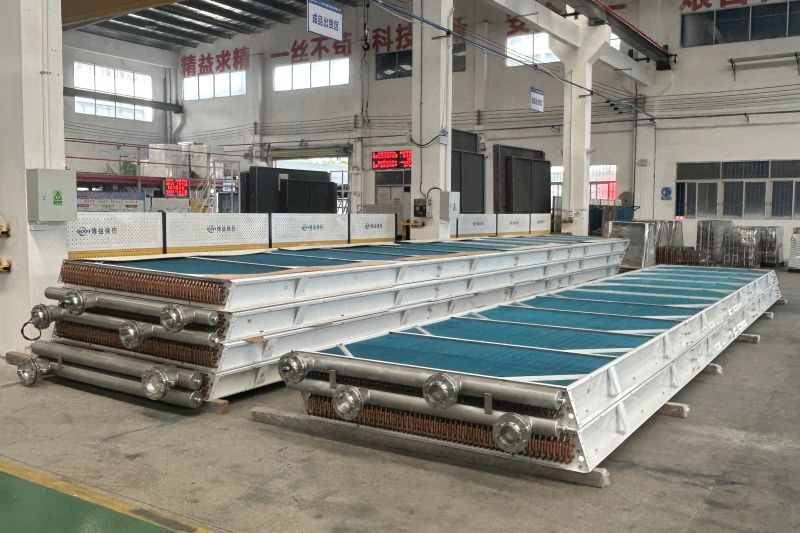
Three methods are used, and each answers a different question. Knowing which one produced a number prevents a buyer from accepting a bench result as proof of field behavior.
Calorimeter Testing
A controlled hot water or glycol loop delivers a known heat load while airflow and temperatures are logged at steady state. Capacity comes from mass flow and enthalpy difference, with an energy balance closure normally within 3%.
Wind Tunnel Testing
A calibrated tunnel sets airflow across the coil face and measures pressure drop against nozzle-derived flow, isolating the airside curve that drives fan selection and the real operating point.
Field Verification
Site testing confirms performance under real conditions including recirculation, fouling, and part load. It validates the installation as much as the equipment.
Best practice is a sequence: bench testing proves the unit meets its guarantee in controlled conditions, then field verification confirms the installation lets it reach that performance. If a supplier offers only one, ask which and why. Where AI workload heat rejection leaves little margin, both are justified.
Leak Testing: Sensitivity Comparison
A circuit that leaks after commissioning is a warranty event that damages reputation more than budget, so test sensitivity should match the consequence of failure, not the cheapest available option.
| Method | Sensitivity | Best Applied To |
|---|---|---|
| Helium mass spectrometry | 1 × 10⁻⁶ mbar·L/s and better | Sealed refrigerant circuits, brazed manifolds |
| Pressure decay (nitrogen) | Detects gross leaks over hours | Large water and glycol circuits |
| Bubble immersion | Visible leaks at joints | Final assembly check, field service |
| Electronic sniffer | Localized point detection | Commissioning of charged systems |
For stainless steel coils in corrosive environments, helium testing plus a pressure decay hold is the practical combination: helium finds the small defects, the decay test proves the circuit holds over time. Document the hold period, the start and end pressures, and the allowable drop. A report stating only "leak test passed" is not verifiable evidence.
Leak integrity follows joint quality, which is why certification and standards review should always be paired with a physical inspection of the welds that will hold the pressure.
Welding Quality Inspection
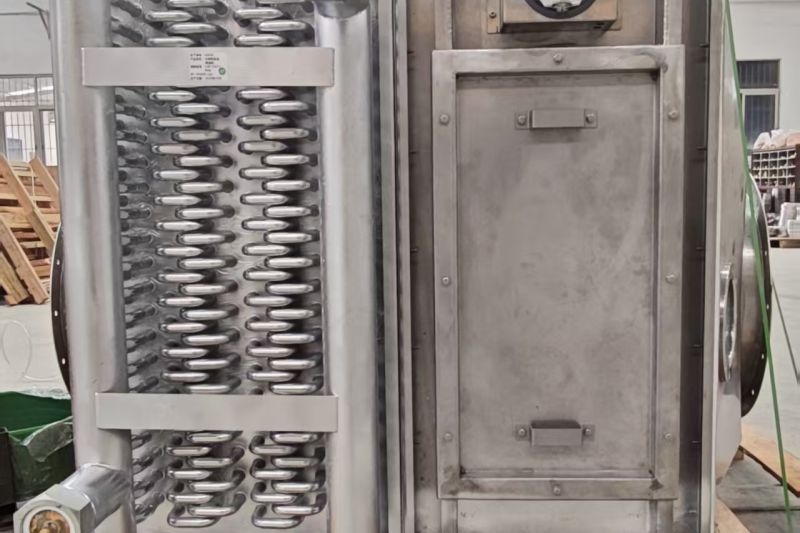
Welds are where leaks begin and where corrosion concentrates. Four techniques are used, each with a defined role in the quality plan.
- Visual inspection: Applied to 100% of joints. Checks bead uniformity, undercut, spatter, heat-tint discoloration, and filler selection. Inexpensive and remarkably effective in qualified hands.
- Radiographic testing (RT): Reveals internal porosity, lack of fusion, and inclusions in butt welds and tube-to-header joints, usually on a sampling basis defined in the quality plan.
- Ultrasonic testing (UT): Detects planar defects that radiography can miss, with no radiation hazard and good performance on thicker sections.
- Dye penetrant inspection: Surfaces cracks at fillet welds and nozzle connections, catching defects that visual inspection cannot see.
The plan should state which joints receive which method and at what sampling rate. A supplier applying RT to 10% of tube-to-header joints and documenting it is more trustworthy than one claiming "full inspection" without scope. For coastal or chemical plants, sound welds and anti-corrosion treatment work together: coating protects the surface, but only sound welds prevent the crevice corrosion coatings cannot reach.
Pressure Testing
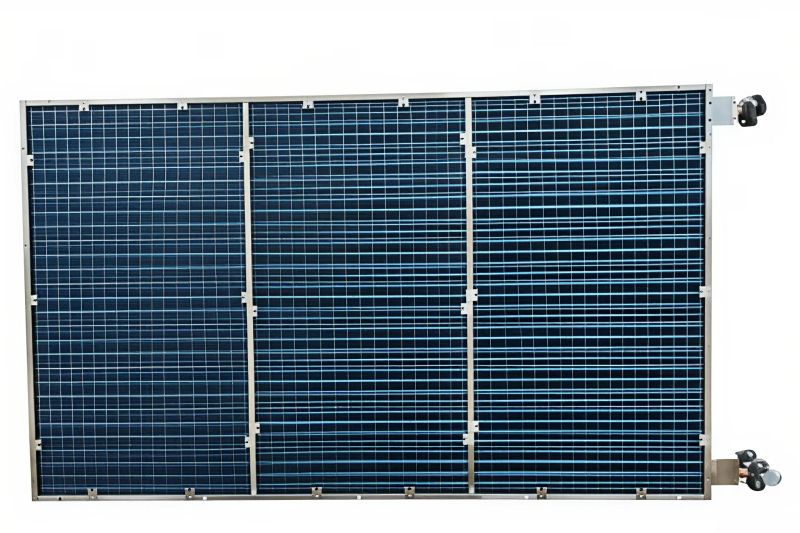
Hydrostatic testing is the structural proof for any pressure-retaining circuit. Water is applied at 1.5 times design pressure, held for a defined period, and every joint is inspected for weeping, permanent deformation, or pressure loss. At high design pressures the test pressure must be calculated to avoid exceeding yield in the weakest component, and that calculation belongs in the record.
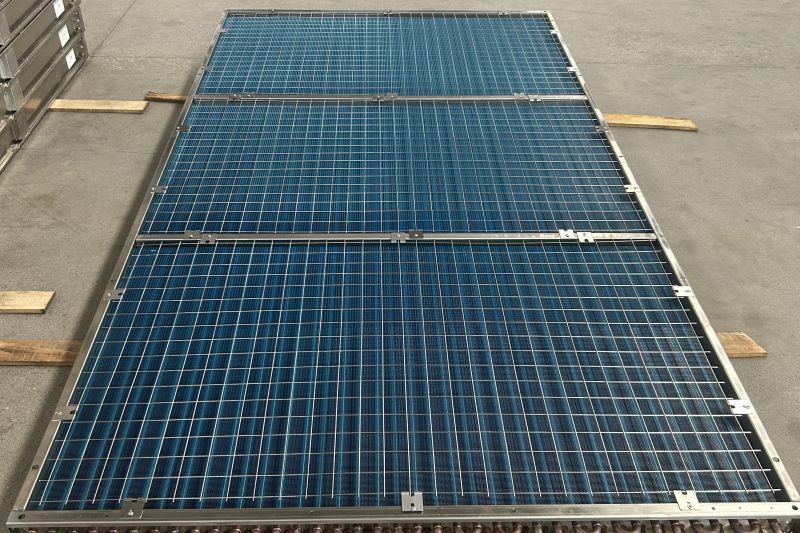
Pneumatic testing is reserved for cases where hydrostatic testing is impractical, such as large airside components or installations where residual moisture is unacceptable. Stored energy in a gas test is substantial, so a written method statement, remote gauging, exclusion zones, and staged pressurization are mandatory. After hydrostatic testing the circuit must be drained and dried, since residual water in a stainless coil initiates corrosion and, in cold climates, risks freeze damage in transit.
Vibration and Noise Testing
Acoustic performance is a permit condition on many sites and noise complaints are hard to resolve retroactively. Sound power level should be measured in a semi-anechoic or reverberant room to a recognized standard and reported as a spectrum, not a single dB(A) figure, because low-frequency fan tones carry further and are harder to attenuate.
Vibration testing complements the acoustic data. Spectrum analysis at operating speed exposes imbalance, bearing defects, and resonance that would otherwise surface as premature failure. Baseline signatures recorded at the factory give maintenance teams a reference point years later, which is the foundation of the predictive maintenance approach operators now expect. For sites near homes or offices, request the guaranteed sound power level and the boundary correction used to derive sound pressure.
Inside a Real Pre-Shipment Inspection
A European client recently sent their own quality engineer to our works before releasing a batch of V-type dry coolers for a data center project. The agenda is a useful template for any factory inspection.
- Appearance and dimensions: Coil face size, fin pitch, tube layout, fan positions, and frame squareness measured against approved drawings.
- Welding review: Header and tube-to-header welds inspected on several units, with dye penetrant applied to selected locations in the client's presence.
- Leak and pressure verification: Units held under pressure during the visit, with readable gauges and a test log available for signature.
- Documentation review: Material certificates, calibration records, and inspection reports checked against the purchase order line by line.
- Release sign-off: The inspector signed only after the sample units passed, converting the visit into a binding quality record.
That visit took one working day and replaced weeks of potential dispute. With more than 20 years of heat engineering experience and exports to over 30 countries, we treat such visits as normal practice and encourage buyers to schedule them early enough that findings can still be corrected in the factory.
What a Proper Test Report Contains
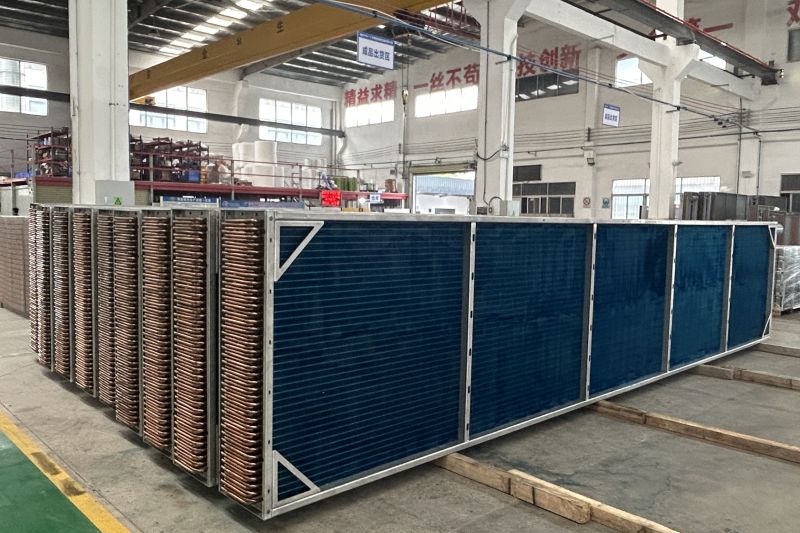
The deviation log is often the most informative page. Every real process produces findings, so a report with zero deviations on a complex custom unit is either excellent or incomplete. A supplier willing to list a reworked weld and its re-test result is showing a working quality system, not a weakness.
The practical sequence is to specify test requirements in the inquiry itself. Our inquiry form accepts inspection and documentation requirements alongside duty and dimensional data, keeping expectations aligned from the first quotation. Reviewing the specifications needed for an accurate quote at the same time removes most later back-and-forth.
Frequently Asked Questions
Should performance testing be witnessed by the buyer?
Witnessed testing is worth the trip for critical or high-value units, and most manufacturers accommodate it with notice. Put witness testing in the purchase order, name the acceptance criteria, and book the date early enough that a failed test can be corrected before the shipping window closes.
How much does third-party inspection add to lead time?
Typically two to five working days depending on scope and inspector availability. The larger schedule risk is discovering a non-conformance late, so booking inspection at the right production stage matters more than its duration.
Is field testing required if factory testing passed?
Not always, but it is recommended for large or complex installations. Factory testing proves the unit; field verification proves the installation. Recirculation, ducting restrictions, and control tuning can degrade site performance even when the equipment meets its guarantee.
Key Takeaways
- Verify five metrics: capacity, approach temperature, airside pressure drop, fan power, sound power level.
- Match leak test sensitivity to the consequence of failure; helium plus pressure decay covers most circuits.
- Require a weld inspection plan with methods and sampling rates, not a generic statement.
- Hydrostatic testing at 1.5x design pressure is the structural baseline; pneumatic testing needs a method statement.
- Insist on a serialized test report with calibration records and a deviation log.
- Schedule witness or third-party inspection early enough to allow correction in the factory.
Need Verified Performance, Not Just a Datasheet?
Tell us your duty, site conditions, and inspection requirements. We will confirm the test protocol, documentation package, and delivery schedule before you commit.