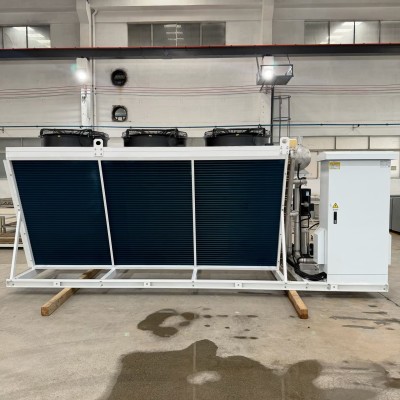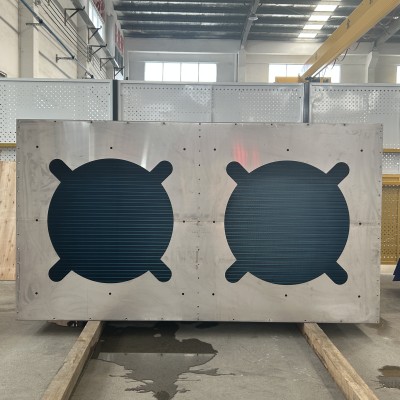


BMS Integration: Connecting Your Dry Cooler to Building Management Systems
Modern facilities no longer treat heating and cooling equipment as isolated machines. A dry cooler that cannot "talk" to the rest of the building is a blind spot: operators discover fan failures after product is lost, run fans at full speed when the load is a fraction of design, and miss easy energy savings that coordinated control would capture. BMS integration solves this by wiring the dry cooler into the same data stream and control logic that governs chillers, pumps, and air handlers.
This guide explains what a building management system does, which communication protocols matter for cooling equipment, how the integration architecture is layered, which data points deserve monitoring, and how a structured implementation project proceeds. It closes with the BMS-ready design that Boyi Cooling builds into its dry coolers and coils as a standard feature.
Quick Answer
Connecting a dry cooler to a building management system means exposing the unit's controller over a standard protocol — most commonly Modbus RTU/TCP or BACnet — mapping key registers (temperatures, fan speeds, alarms, power), and layering control functions such as remote start/stop, setpoint adjustment, and scheduling into the BMS. The payoff is coordinated plant control, earlier fault detection, and typically 10–25% lower cooling energy through load-matched fan operation and free-cooling optimization.
Why BMS Integration Is No Longer Optional
Twenty years ago, a dry cooler shipped with a local controller, a display, and maybe a hardwired alarm relay. Facility teams accepted that arrangement because energy was cheap and monitoring meant walking to the roof. Three forces have changed that expectation:
- Energy cost scrutiny. Cooling can represent 30–40% of a facility's electricity use. Executives now ask for verified kWh per unit of heat rejected, and that number only exists when the dry cooler reports into the same metering and analytics platform as the rest of the plant.
- Staffing reality. One technician often covers an entire campus. Remote visibility — seeing approach temperatures, fan statuses, and alarm history from a desk or a phone — is the difference between a five-minute correction and a weekend failure.
- Certification and ESG reporting. Programs such as LEED and BREEAM reward demand-controlled operation and continuous commissioning, both of which presuppose that cooling equipment is integrated and its data is logged.
For data centers, the stakes are higher still. Operators pursuing PUE targets treat the dry cooler's control integration as a baseline requirement in purchase specifications, alongside capacity and fan efficiency.
What a Building Management System Actually Does
A building management system (BMS) — also called a building automation system (BAS) — is the supervisory layer that monitors, controls, and optimizes a facility's mechanical and electrical systems. Its core functions are:
- Monitoring: Collecting real-time values from thousands of field points and presenting them on dashboards and trend charts.
- Control: Issuing commands — start/stop, speed references, valve positions, setpoints — to equipment controllers according to schedules and logic sequences.
- Optimization: Running higher-level strategies such as optimal start, demand limiting, and coordinated sequencing across chillers, pumps, and heat rejection equipment.
- Alarming: Prioritizing faults, escalating unacknowledged events, and archiving alarm history for maintenance analysis.
The dry cooler fits into this picture as both a data source and a controlled asset. Its controller computes leaving-fluid temperature, stages or modulates fans, and protects the loop against freeze and overpressure — while the BMS supervises: adjusting setpoints by season, trimming fan speed to actual load, and coordinating heat rejection with chiller staging so the whole plant runs at minimum combined cost.
Communication Protocols: Which One to Choose
The protocol is the language the dry cooler's controller uses to exchange data with the BMS. Four families dominate industrial and commercial projects:
| Protocol | Type | Typical Use | Strengths | Watch-outs |
|---|---|---|---|---|
| Modbus RTU | Serial (RS-485) | Legacy plants, simple point-to-point links | Ubiquitous, simple, free specification | Slow polling, no standard data model, 247-device limit per segment |
| Modbus TCP | Ethernet | Newer retrofits, controller-to-controller links | Uses standard IP networks, easy gateway support | Still register-based; naming conventions vary by vendor |
| BACnet IP / MS/TP | Native building protocol | Commercial HVAC, campus-wide systems | Rich object model, interoperability certified by BACnet Testing Laboratories | More configuration effort; device profiles must match (B-BC, B-AAC) |
| OPC UA | Platform-independent | Industry 4.0 plants, data centers with IT/OT convergence | Semantic data model, encrypted, scales to cloud analytics | Higher integration skill requirement; less common on compact units |
| KNX | Building bus | European commercial buildings, room-level control | Strong in lighting/HVAC room control | Rarely the backbone for outdoor heat rejection equipment |
Practical selection advice: if the BMS vendor specifies BACnet, require a BTL-listed BACnet interface on the dry cooler. If the plant is Modbus-based, ask for both RTU and TCP so the unit can sit on an existing RS-485 trunk or jump straight onto the IP network. For data center operators standardizing on OPC UA or MQTT for analytics, a gateway approach (below) usually wins over native support.
One more criterion matters more than vendors admit: the quality of the published point list. A protocol is only as useful as its register map. Boyi Cooling supplies a documented, versioned data point table with every BMS-ready unit — including scaling factors, data types, and read/write attributes — so the integrator does not reverse-engineer registers on site.
Integration Architecture: From Field Controller to Dashboard
A well-structured integration has four layers, each with a clear job:
Field Layer
Sensors (fluid in/out temperature, ambient, pressure) and actuators (EC fan speed drives) wired to the dry cooler's own controller. This controller always keeps local safety logic — it must protect the unit even if the network drops.
Protocol Layer
The unit controller serves its point list over Modbus/BACnet. Where protocols differ on each side, a gateway (for example Modbus-to-BACnet) translates between them without touching control logic.
Supervisory Layer
The BMS server polls or subscribes to the unit's data, stores trends, runs scheduling and optimization, and enforces user permissions for control actions.
Interface Layer
Dashboards, alarm consoles, mobile apps, and APIs for analytics platforms — the screens your team actually uses every day.
Two design rules prevent most field problems. First, keep failsafe behavior local: if communication is lost, the dry cooler should fall back to its last valid setpoint or a safe default, not to a hard stop. Second, define authority levels explicitly — the BMS may trim setpoints within an agreed band (say ±3 K), but safety trips and fan stage protections remain exclusively with the unit controller.
Key Data Points Worth Monitoring
Not every register deserves dashboard space. These are the points that earn their place on the trend log:
Fluid Temperatures
Supply and return temperature, plus computed approach (leaving fluid vs. ambient). A drifting approach is the earliest sign of fouling or fan degradation.
Fan Speed & Status
Speed reference versus actual feedback per fan. Mismatch reveals VFD faults or mechanical issues long before a trip.
Alarm & Trip Status
High pressure, freeze protection, sensor faults, communication loss — each with a timestamp and priority for escalation logic.
Power Consumption
Fan electrical input (measured or estimated from speed) turns the dry cooler into a reportable energy asset for ESG dashboards.
Ambient Conditions
Outdoor dry-bulb (and humidity where adiabatic pads are fitted) enables free-cooling window analysis and wet-pad control.
Runtime Hours
Per-fan operating hours drive condition-based maintenance instead of fixed calendar service.
A word of discipline: poll conservatively. Trending fluid temperatures every 30–60 seconds is plenty; polling every second across dozens of units floods RS-485 segments and creates the very communication faults the BMS is meant to catch.
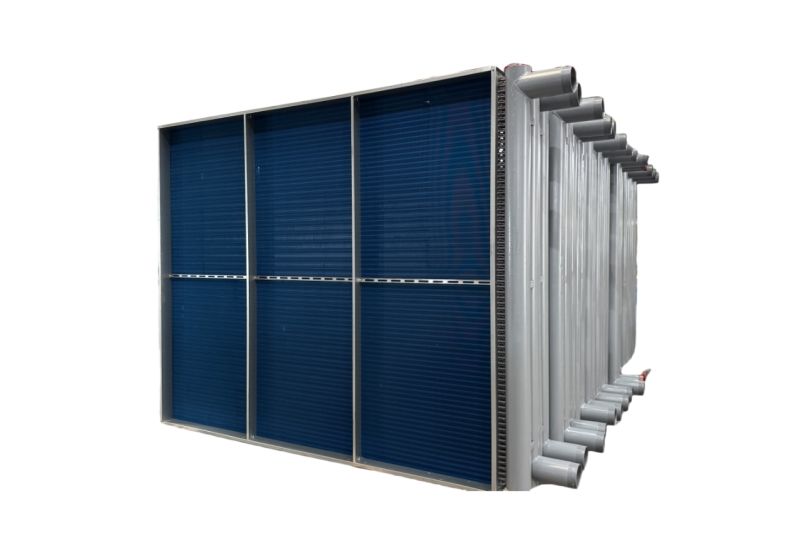
Custom Chilled Water Coils with Stainless Steel Tube and SS Fin
Chilled water coils are heat exchange components used in HVAC systems to transfer heat between air and chilled water. Built for long service life in demanding hydronic systems.
View Product DetailsControl Strategies That Unlock Efficiency
Monitoring is passive; value comes from what the BMS is allowed to do. Four strategies cover most projects:
- Remote start/stop with interlocks. The BMS starts the dry cooler only when its fluid loop is proven (pump running, flow switch closed), preventing dry running and nuisance trips.
- Setpoint reset. Leaving-fluid temperature setpoint floats with actual load and ambient instead of being fixed at a winter design value. Letting the setpoint rise 2–3 K in mild weather cuts fan power dramatically — fan laws mean a 20% speed reduction saves roughly 50% of fan energy.
- Scheduling and occupancy logic. Night setbacks, weekend profiles, and holiday overrides written once in the BMS rather than reprogrammed at each unit.
- Alarm escalation. A high-ambient warning becomes a work order if unacknowledged in 30 minutes; a freeze-protection trip pages a human immediately. Defined escalation turns raw alarms into managed maintenance.
For plants with multiple dry coolers in parallel, the BMS adds staging intelligence: running four fans at 60% instead of two at 100% improves heat transfer and cuts sound power, while N+1 rotation equalizes wear across units.
Coordinated Energy Optimization Across the Plant
The largest savings appear when the BMS coordinates the dry cooler with everything connected to it:
- Chiller staging. When ambient falls, the BMS can lower condenser water (or loop) temperature setpoints, letting chillers run at lower lift. Each kelvin of lower condensing temperature is worth roughly 2–3% of chiller energy.
- Free-cooling sequencing. Below the changeover temperature, the BMS shifts to full free cooling — compressors off, dry cooler fans modulating to hold setpoint. In temperate and cold climates this mode covers thousands of hours per year.
- Pump-fan balancing. Higher loop flow moves capacity between components; coordinating pump and fan speeds finds the minimum combined input power rather than optimizing each in isolation.
- Demand limiting. During utility peak windows, the BMS can pre-cool thermal mass and trim fan power without breaching temperature guarantees.
Operators who implement coordinated control typically report 10–25% annual cooling-energy savings versus isolated unit control, with the largest share coming from extended free-cooling windows and setpoint reset.
Implementation Guide: Integrating a Dry Cooler into an Existing BMS
A structured project avoids the classic failure mode of "it communicates, but nobody trusts the data." Eight steps, in order:
Collect specifications. Confirm the dry cooler's available protocols, the point list with scaling, and the BMS side's driver and spare capacity.
Design the network. Decide RTU trunk versus IP drop, assign addresses, verify cable segregation and shielding for RS-485 runs near power equipment.
Map and name points. Apply your facility's naming convention to every register; agree write permissions per point before configuration starts.
Integrate and verify. Commission the link, then validate a sample of points against local instrument readings — including one deliberate communication-loss test.
Configure control logic. Implement scheduling, setpoint bands, and interlocks with the authority limits agreed in design.
Trend and tune. Run two to four weeks of trends, compare fan energy and approach against baseline, adjust schedules and staging.
Document and hand over. Deliver the final point list, as-built network drawing, and alarm philosophy to the operations team.
Continuous commissioning. Review trends quarterly; integration value decays when schedules drift from how the building is actually used.
Boyi Cooling's BMS-Ready Design
BMS integration is engineered into Boyi Cooling equipment from the factory, not bolted on afterward. With more than 20 years of thermal engineering experience and custom manufacturing capability, Boyi builds control readiness into every dry cooler and coil it ships:
Protocol Support
Modbus RTU/TCP as standard; BACnet and gateway-based OPC UA options for campus and data center projects.
Documented Point List
Every BMS-ready unit ships with a versioned data point table — registers, scaling, data types, read/write attributes.
Local Failsafe Logic
Unit controllers retain full safety protection and fallback behavior during communication loss, by design.
Global Project Experience
Equipment delivered to 30+ countries, integrated into buyer-specified BMS platforms from Modbus plants to BACnet campuses.
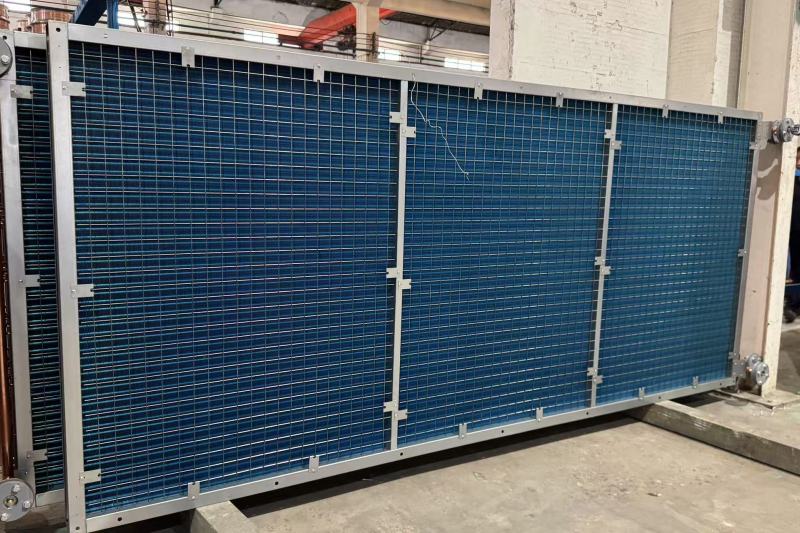
Because Boyi customizes each unit — coil configuration, fan count, EC motor selection, and controller I/O — the BMS interface is specified together with the thermal design. Whether the project pairs a V-type dry cooler with a chilled-water plant or integrates custom chilled water coils into an AHU controlled by the same BMS, the control architecture is engineered as one system. To review a sample point list or discuss a specific integration, contact our engineering team or send an inquiry with your protocol requirements.
Frequently Asked Questions
Can an older dry cooler be retrofitted for BMS integration?
Usually yes. If the existing controller has a communication port, integration may only need configuration. Otherwise, a standalone gateway that reads the unit's I/O and serves BACnet or Modbus to the BMS is a proven retrofit path — often completed without replacing the cooler itself.
What happens if the BMS connection fails?
A properly specified dry cooler keeps running. Local control executes its failsafe: last valid setpoint or a safe default, with local freeze and pressure protection always active. The unit flags the communication loss as an alarm the moment the link is restored — or immediately, via a hardwired relay that many facilities keep in parallel for critical units.
Modbus or BACnet — which should we specify for a new dry cooler?
Follow your plant's existing backbone. Modbus TCP suits industrial sites and data centers with register-based integrations; BACnet suits commercial campuses where the BMS vendor is BACnet-native and BTL-listed device profiles matter. The deciding factor is not the protocol's capability but the point-list quality and integration support the manufacturer provides.
Key Takeaways
- BMS integration turns a dry cooler from an isolated unit into a supervised, optimizable plant asset — expect 10–25% cooling-energy savings from coordinated control.
- Modbus RTU/TCP and BACnet cover most projects; OPC UA matters for IT/OT-converged data centers. Choose by backbone, then demand a documented point list.
- Keep safety logic local: the unit controller must protect the equipment even when the network is down, with defined authority limits for BMS writes.
- Monitor the points that drive action — approach temperature, fan feedback, alarms, power — and poll conservatively.
- Boyi Cooling ships BMS-ready dry coolers and coils with standard protocol support, versioned point lists, and local failsafe design, backed by 20+ years of custom thermal manufacturing.
Planning a new dry cooler or a BMS retrofit? Boyi Cooling engineers custom solutions with integration built in.
Request a BMS-Ready Quote